
-853X543.jpg)
PRATIBHA SUMAN: REFUSING PRESCRIBED BOUNDARIES
by Vinta Nanda July 25 2026, 12:00 am Estimated Reading Time: 11 mins, 47 secsFrom a small-town childhood to theatre, cinema, poetry and cultural activism, Pratibha Suman tells Vinta Nanda how independence shaped her feminism, politics and art, and why women must continue speaking for themselves.
There are artists whose politics emerge from books, movements and manifestos, and there are those for whom politics begins much earlier—in the home, the family, the restrictions placed upon a girl, and the first moment she understands that the world expects something different from her simply because she is female.
Pratibha Suman belongs unmistakably to the latter.
Actor, theatre practitioner, filmmaker, poet and cultural organiser, Suman's journey has travelled through several creative worlds. Yet, speaking about her life, what emerges is not a collection of separate careers but a single continuum. Theatre, feminism, cinema, poetry and politics appear to have grown from the same instinct: the need to observe society closely and question what it considers normal.
The beginnings were far removed from the cultural institutions she would eventually inhabit. Growing up in and around Jalgaon, in Maharashtra's Khandesh region, Suman remembers a childhood in which theatre exerted an extraordinary pull. Professional theatre was not easily accessible. Watching a play could mean walking kilometres. Yet she went.
That determination—to get to wherever the world she wanted was happening—would become one of the recurring patterns of her life. She was also growing up within a social environment where the trajectory prescribed for girls was clear. Education could continue only so far before marriage became the overriding concern. By the tenth or twelfth standard, she recalls, families were already thinking about marrying their daughters.
Suman, meanwhile, was thinking differently. “I don't know why,” she says, “I always had independent thinking.” That independence would prove consequential.
The Mother Who Opened Doors
If Suman's life became an argument against restrictions placed upon women, one of its earliest influences was her mother. Her mother was a teacher. She dressed traditionally, keeping her pallu over her head, yet Suman remembers her as fundamentally modern—not because of appearance, but because of what she believed her daughter deserved.
She wanted the girl to study. When Suman's father considered stopping her education after the tenth standard, her mother intervened and insisted that she be allowed to continue. For Suman, this distinction remains important. Modernity cannot be measured by clothes or outward behaviour. A woman who covered her head could nevertheless make a radically progressive choice by insisting upon her daughter's education.
That decision mattered because education was not merely academic advancement for Suman. It opened the possibility of another life. Eventually, that possibility acquired a name: the National School of Drama.
The Journey To NSD
For a young woman from her circumstances, NSD was not simply an institution to which one casually applied. Getting there required overcoming family anxiety, financial limitations, distance and the expectation that marriage should take precedence. Her family worried that she was already reaching an age when she ought to marry. NSD seemed almost irrelevant beside that urgency. Suman went anyway.
Her recollections of travelling to Delhi contain the vulnerability and excitement of someone entering an unfamiliar world with limited resources. She remembers arranging money for the ticket, making the journey to Delhi and arriving around Mandi House, carrying her belongings and navigating accommodation before the hostel opened.
Hundreds competed for a handful of places. She was selected.
Back home, the news began appearing in newspapers: a girl from their region had reached NSD. She remembers being described as perhaps the first girl from Khandesh to do so. The very achievement that had initially seemed difficult for the family to accommodate became something the community could recognise with pride.
But NSD represented something deeper than professional training. It confirmed that the world could be larger than the one prescribed for her.
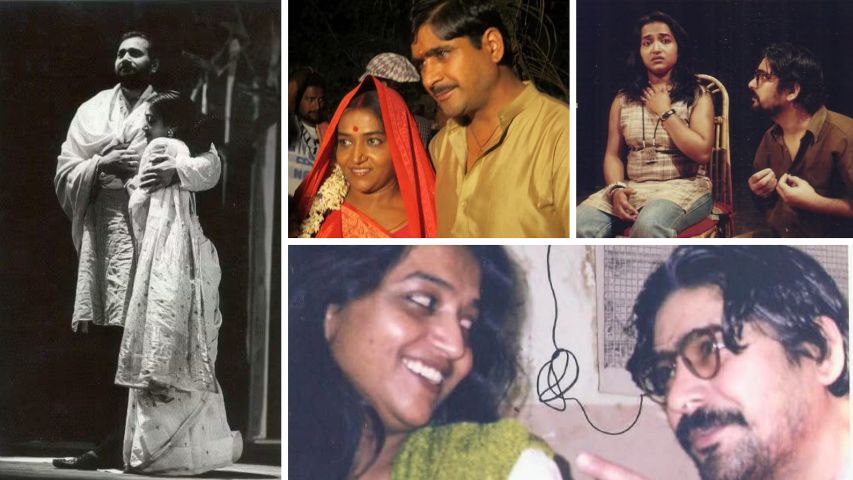
Theatre As Social Inquiry
Suman's relationship with theatre has never been merely about performance. When she speaks of playwrights she admires, she repeatedly returns to writers who interrogate social structures. Vijay Tendulkar and Mahesh Elkunchwar occupy an important place in her imagination, alongside her appreciation of Mohan Rakesh. What attracts her particularly to Tendulkar is the social architecture within his writing—the structures beneath individual behaviour, the things society leaves unsaid.
That distinction illuminates Suman's own artistic instincts. She is interested not simply in what a character does, but in what makes a person behave that way. What family structure produced the action? What gender arrangement? What caste hierarchy? What economic or religious framework?
It is why she believes important theatre from earlier decades can remain startlingly contemporary. The social questions have not disappeared. Neither, she says, has casteism. Nor have the structures built around religion simply vanished. The universality of those older plays comes precisely from the uncomfortable persistence of the realities they examined. For Suman, therefore, revival is not nostalgia. It can be confrontation.
When Life Interrupted The Artist
The conventional narrative of an artistic career often moves cleanly from training to opportunity to accomplishment. Women's lives rarely cooperate with that structure. Marriage and motherhood altered Suman's professional journey profoundly. She speaks about difficult pregnancies and miscarriages and about periods when she was forced to withdraw physically from work.
One pregnancy required prolonged bed rest. For an intensely active creative person, confinement was devastating. She describes the period as extremely difficult. Yet something unexpected happened inside that forced stillness. Ideas began arriving. She developed concepts while lying down. Rather than accepting inactivity as the end of her creative momentum, she began imagining another form through which those ideas might eventually live: cinema.
Later, she undertook filmmaking training, learning the mechanics of the medium, including camera placement and the practical language of making films. Even when another pregnancy interrupted the course, she eventually completed it. The interruption had created another artist.
95.jpg)
Becoming A Filmmaker
Gradually, Suman began directing the concepts she had developed. Short films followed. Then came documentary work. Her engagement with social work took her into Adivasi communities, and those encounters became crucial to both her filmmaking and her understanding of women.
She made a documentary rooted in that world and began submitting it to Indian festivals. Then something unexpected happened. Awards started coming. One festival recognised the film, then another, and another. Suman remembers the moment with infectious simplicity: “Yes, now I become the filmmaker.”
The sentence contains none of the solemnity with which artistic identities are often constructed. She had made the work, sent it into the world, watched audiences and festivals respond—and discovered another dimension of herself.
Filmmaking also intensified questions that had followed her from childhood. Who decides how a woman should live? Who determines what marriage should look like? Who possesses the right to leave? Who is economically independent enough to choose? And what does a supposedly modern society have to learn from communities it routinely labels backward?
Feminism Beyond The Slogan
Suman's feminism is compelling precisely because she does not describe it as an abstract ideological position. It emerges through experience.
She has seen what happens when girls are told that marriage is more urgent than education. She has watched women negotiate power within families. She has experienced motherhood and professional interruption. She has worked in communities where relationships operate differently from mainstream urban assumptions. Her encounters with Adivasi women particularly challenged conventional ideas of progress.
She speaks of seeing women with greater agency in certain aspects of relationships and marriage than women living within social systems that consider themselves more sophisticated. The experience pushed her to examine how social structures determine women's choices.
For Suman, feminism therefore cannot stop at representation. Women have to possess agency. They have to participate in society. And above all, they have to speak. “Continuously women have to say something about themselves,” she says. That speaking, she insists, must continue. A society cannot function while simultaneously demanding women's contribution and attempting to confine them to the home.
Poetry As Political Consciousness
It is perhaps inevitable that Suman eventually found poetry. Asked where her writing comes from, she gives an answer that could serve as a description of her entire artistic life: “Social sensitivity.”
Her poems do not exist separately from the worlds she has inhabited. She speaks about the intellectual nourishment provided by friendships with social workers, political thinkers and others engaged with society.
A creative person, in her view, grows according to the soil surrounding them. That idea becomes important when considering how personal her poetry is. Suman resists the assumption that every poem must be decoded as autobiography. If we insist upon searching for Gulzar's personal biography inside everything he writes, she argues, we may fail to encounter Gulzar the artist. The same applies to Amrita.
Creativity is more mysterious than transcription. “Wisdom is somewhere,” she says. “We are the channels.” The artist receives something from the environment—from social structures, observation, experience, history, other people—and transforms it.
Her poetry, then, may originate in personal sensitivity without being confined to personal history. That is what makes it political.

Women, Myth And The Unasked Question
Suman's engagement with women also enters the territory of mythology and inherited narratives. Women such as Sita, Urmila and Yashodhara become opportunities to ask questions rather than repeat familiar reverence. What happens when these women are considered as individuals rather than supporting figures in men's spiritual, heroic or historical journeys?
What did obedience cost them? What possibilities were denied to them? What does society celebrate when it celebrates sacrifice?
Her poetry approaches such questions from the perspective of a woman who has spent a lifetime noticing the distance between the roles assigned to women and the lives they might have chosen for themselves. It is here that poetry, feminism and politics become indistinguishable.
The Politics Of Human Relationships
Suman's political concerns extend beyond formal politics. She worries about something more elemental: the deterioration of relationships between human beings. She speaks of the “fabric” of society being damaged—the love between people, the beauty contained in relationships, the ability to recognise another person's humanity.
“Insaan ke insaan kai dusre se ju taalmel hai, wo jo prem hai, wo jo sundarta hai doosre ki rishto ki, wo khatam…” she says in the conversation: the connection between human beings, the love and beauty of relationships, are disappearing.
Her concern about violence against women belongs within this larger crisis. Misogyny is not an isolated malfunction. Neither is caste prejudice. Neither is religious division. They reveal something damaged in the way society has learned to see another human being. That is why she is uneasy about the present political moment. She fears that progress once assumed to be permanent may not have been permanent at all.
At one point she suggests that whoever comes to power next will have enormous work to do, because society may have moved backwards by decades. And then she expands the thought. It is not merely India. The whole world, she fears, has moved backwards.
Cinema Must Go Beneath Surfaces
Suman brings the same impatience to contemporary cinema. She believes Indian cinema and theatre too often engage with social realities at a superficial level. Her comparison with cinema from southern India is revealing. What she values is rootedness—the ability to borrow a broad cinematic idea perhaps, but transform it through local soil, behaviour and culture until audiences believe the world they are watching.
Authenticity does not require women to remain passive. A woman may be doing ordinary domestic work one moment and become a fighter the next, Suman argues, and audiences will believe her if the character has been created from a recognisable cultural reality.
The lesson returns us to her earliest attraction to socially conscious theatre. Art must know where it comes from.
Creating Spaces For Other Voices
Today, Suman's creative life extends beyond making her own work. Alongside fellow NSD alumnus Yashpal Sharma, her husband, she is involved in the Bollywood International Film Festival, creating a platform for independent cinema.
The festival began under extraordinary circumstances, during the COVID period, when physical cultural spaces had effectively disappeared. An online edition drew a strong response. Restrictions made subsequent physical editions difficult, forcing the organisers to negotiate changing circumstances and continue building the festival.
There is something fitting about this evolution. The girl who once travelled towards theatre now helps create a destination towards which other artists can travel. The actor became filmmaker. The filmmaker became poet. The poet became organiser. Yet none of these identities has displaced the others.
The Right To Keep Speaking
Perhaps the most revealing thing about Pratibha Suman is that she does not narrate her journey as heroic.
There are struggles, accidents, interruptions, encounters and discoveries. A door closes and she finds another medium. A period of physical confinement produces film ideas. Social work becomes documentary cinema. Personal observation becomes poetry. A festival becomes a means of creating opportunities for other filmmakers.
Running beneath everything is the independence she remembers possessing from childhood. It is not independence as isolation. It is the freedom to think. To question. To recognise that tradition and modernity are more complicated than appearances suggest.
To understand that feminism begins not with declarations but with whether a girl is allowed to study. To see that creativity is simultaneously personal and larger than the self. To understand politics not merely as elections and governments, but as caste, gender, religion, marriage, family and the distribution of power inside everyday life.
And to understand that silence is itself political. That may explain why Suman's observation about women speaking feels like the natural conclusion to her story. Women must continue saying something about themselves. Again and again. Because every generation that believes the battle has been completed risks discovering that the structures it challenged have merely changed shape.
For Pratibha Suman, the response is neither despair nor retreat. It is expression. On stage. Through the camera. In poetry. And in every space where a woman claims the right to tell the world who she is.



-173X130.jpg)
-173X130.jpg)
-173X130.jpg)


-173X130.jpg)
-173X130.jpg)