
-853X543.jpg)
WHEN CLAY BECOMES LIVING POETRY
by Arnab Banerjee July 21 2026, 12:00 am Estimated Reading Time: 8 mins, 21 secsArnab Banerjee finds out how Poettery founders Anubir Singh and Bhavana transformed handcrafted ceramics into a philosophy of design, mindfulness, and soulful living, creating timeless interiors where artistry, memory, craftsmanship, and imagination coexist beautifully.
Where Clay Finds Poetry, Design Finds Soul. Every meaningful space begins with a story.
Before walls acquire character, before furniture assumes purpose, before colour breathes warmth into architecture, there exists an invisible impulse—the desire to belong. Great design is born not from ornamentation but from memory, emotion, and imagination. It transforms the ordinary into the extraordinary, allowing spaces to become repositories of lived experience rather than mere collections of beautiful objects.
This is the philosophy that has quietly guided Poettery for more than three decades.
Nestled in Gurugram yet reaching far beyond geographical boundaries, Poettery is not simply a design studio. It is an evolving artistic universe where clay converses with wood, metal, architecture and poetry; where handcrafted objects become vessels of memory; and where interiors are conceived not as decorative statements but as deeply personal landscapes that mirror the lives of those who inhabit them.
Small-Town Beginnings, Limitless Dreams
Behind this extraordinary creative enterprise stand two remarkable artists—Anubir Singh and Bhavana—whose journey is as compelling as the work they create.
Their story does not begin in celebrated art capitals or cosmopolitan centres of design. It begins in smaller Indian cities where creative aspirations often struggle against convention, where careers in the arts are regarded with uncertainty, and where imagination frequently outgrows its surroundings.
Yet it is precisely from these unlikely beginnings that enduring artistic voices are forged.
For Anubir Singh, childhood in Meerut offered little indication that he would one day become one of India's most original ceramic artists and designers. A student of St. Mary's Academy, he consistently excelled in drawing, instinctively gravitating towards painting and Indian classical music. Artistic pursuits, however, were rarely viewed as practical ambitions.
"I was always the best in drawing," he recalls with characteristic understatement, "but becoming an artist seemed almost impossible." His parents admired education and valued culture, yet they were worried about the uncertain future that accompanied a life devoted to art.
"What comes after art?" was the question he heard repeatedly. Obviously, art didn't figure as a career option. Looking back, he smiles as he describes himself as the family's "black sheep"—the son whose passions lay in painting, music, and creativity rather than convention.
For Bhavana, the journey began within a more nurturing creative environment. Growing up with an architect father, artistic expression was woven naturally into everyday life. Curiosity was encouraged, imagination celebrated.
"There was always creativity around me," she reflects. "It felt completely natural."
Neither, however, could have anticipated the profound transformation that awaited them in Baroda. It was at the Faculty of Fine Arts, Maharaja Sayajirao University, that destiny quietly introduced them to one another.
While Bhavana immersed herself in ceramics, discovering the extraordinary expressive possibilities of clay, Anubir explored the bold visual language of woodcut printmaking. Their individual artistic journeys converged, gradually evolving into a lifelong creative partnership rooted in mutual respect, shared curiosity, and an unwavering commitment to excellence.
If there is one place both artists credit with shaping their creative consciousness, it is Baroda. Almost instinctively, they complete one another's thoughts. "Baroda opened our vision."
For them, Baroda represented far more than an art school. It was liberation. "It gave me the freedom to become myself," Bhavana recalls. "There were no rigid definitions of what art should be. Teachers like Ghulam Mohammed Sheikh encouraged us to discover our own language rather than imitate anyone else's. That freedom changed everything."
Anubir echoes the sentiment with equal conviction. "There were no restrictions. No boundaries. No one dictated how you should think or what was acceptable. Coming from Meerut, it felt like discovering an entirely different world."
In Baroda, experimentation was not merely permitted—it was expected. Ideas mattered more than convention. Curiosity was celebrated. Individuality became a virtue.
.jpg)
From Therapy to Poettery
Armed with postgraduate degrees in Industrial Design from the prestigious IDC, IIT Bombay, the young artists imagined that professional success would naturally follow. Instead, reality proved considerably harsher. Their greatest struggle began only after graduation.
Like so many artists determined to pursue an independent vision, they discovered that talent alone never guarantees recognition. Every opportunity demanded perseverance. Every commission required patience. Every new direction involved risk.
Yet uncertainty has a curious way of revealing purpose. More than thirty-two years ago, an unexpected accident altered the course of their lives. During rehabilitation, one of them was advised to work with clay as a therapeutic exercise to restore flexibility to strained muscles. What appeared to be a simple medical recommendation soon became an extraordinary artistic revelation.
The first encounter with clay felt instinctively transformative. Its softness invited touch. Its silence invited conversation. Its infinite possibilities invited imagination. Therapy gradually became meditation. Meditation became craftsmanship. Craftsmanship evolved into vocation. And vocation ultimately blossomed into Poettery.
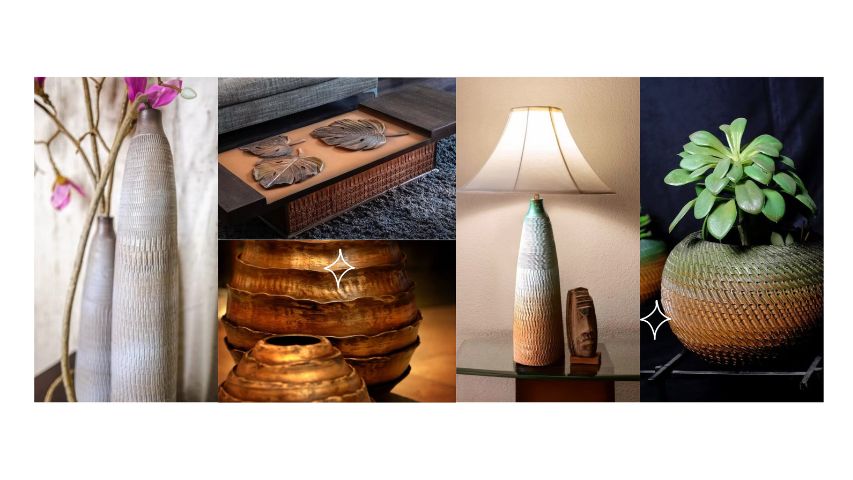
Crafting Spaces with Soul
From those humble beginnings emerged a practice distinguished by patience, discipline and relentless experimentation. The journey began with modest five-inch vessels shaped lovingly by hand.
Over the years those intimate forms expanded into monumental six-foot urns commanding architectural spaces with quiet authority.
Yet scale was never the true measure of their achievement. What continually evolved was their relationship with material itself. Clay ceased to be merely a medium. It became a philosophy.
Drawings gave way to sculptural ceramic murals whose richly textured surfaces capture movement, memory and narrative. Functional pottery gradually expanded into architectural installations, bespoke furniture and immersive interiors where handcrafted ceramics merge seamlessly with reclaimed wood, forged metal and natural stone.
Each project dissolves the traditional boundaries separating art from design, sculpture from architecture and functionality from beauty. Within every Poettery interior, objects possess emotional gravity. Nothing exists merely for decoration.
Every handcrafted mural, every sculpted vessel, every table, every wall, every carefully chosen material contributes to an unfolding narrative uniquely belonging to its inhabitants. Rather than imposing a signature style, Bhavana and Anubir create environments that quietly reveal the personalities of those who live within them.
This rare sensitivity has made Poettery one of India's most admired names in contemporary handcrafted design.
89.jpg)
Art, Yoga, and a Philosophy of Living
Their distinctive body of work—an elegant confluence of poetry and pottery—has been exhibited across the country, including prestigious showcases at Vimonisha Art Gallery, Chennai, where collectors and connoisseurs have long recognised the remarkable originality of their artistic language.
Yet perhaps what distinguishes Poettery most profoundly is its refusal to separate creativity from life itself.
Beyond their studio practice, Bhavana and Anubir also guide the Ekagrata Sivananda Yoga Centre in Gurugram, integrating the disciplines of yoga, mindfulness and artistic practice into a holistic philosophy of living.
For them, shaping clay and cultivating inner stillness emerge from the same source. Both require patience. Both demand surrender. Both celebrate presence.
The result is a body of work that feels remarkably timeless—objects and spaces that resist fashion because they arise from something infinitely deeper than trend. They also add metal, wood, and other design elements to complete their unique vision.
After more than three decades of unwavering dedication, Poettery has become far more than a successful design practice. It is an enduring testament to the transformative power of imagination.
It reminds us that extraordinary creativity does not depend upon birthplace, privilege or circumstance. It flourishes wherever courage meets curiosity, wherever craftsmanship is pursued with integrity, and wherever artists remain faithful to the quiet voice of their own imagination.

Quiet Excellence, Enduring Legacy
What is perhaps most remarkable is that, despite earning widespread acclaim and creating bespoke works for an illustrious clientele—including Amitabh Bachchan, the late filmmaker Mukul Anand, and numerous distinguished patrons across Delhi, Mumbai, Bengaluru, and beyond—Anubir and Bhavana have never actively sought the spotlight. In an era driven by relentless self-promotion and digital visibility, their quiet confidence has remained refreshingly steadfast.
"We have never believed in promoting our brand," they say with characteristic humility. "It is our clients who become our ambassadors. Through word of mouth, they introduce us to people who share a similar sensibility and appreciation for handcrafted art and thoughtful design."
Their reputation, built patiently over three decades, has grown not through advertising campaigns or carefully orchestrated publicity, but through the enduring quality of their work and the trust it inspires. Every commission has led naturally to another, every satisfied patron becoming an advocate for the philosophy that lies at the heart of Poettery.
As they look towards the future, there is a quiet reassurance that the creative legacy they have nurtured with such devotion will continue to evolve. Their extraordinarily gifted daughter, Tasha Singh, now based in the United States, represents the next chapter in this remarkable artistic lineage. Endowed with the same instinctive sensitivity to form, beauty, and creative expression, she carries forward not merely a family tradition, but a philosophy of making that honours craftsmanship, authenticity, and imagination.
A singular confluence of her parents' creative genius, she is not one to merely tread the well-worn path they forged. Instead, she has chosen to chart a course defined by purpose rather than inheritance. To her, the privilege of giving back to the society that nurtured and shaped her holds far greater significance than the mere pursuit of material success. Service, for her, is not an alternative to ambition—it is its highest expression.
The Next Chapter
If Poettery has always been about shaping clay into poetry, its future appears equally luminous, with Tasha poised to become yet another radiant custodian of a legacy built not on fame, but on passion, integrity, and the enduring power of art.
In every vessel shaped by hand, every mural carved into clay, every interior composed with thoughtful restraint, Bhavana and Anubir continue to affirm a simple yet profound truth: that beauty is not manufactured. It is cultivated. Patiently. Soulfully. One story at a time.




-173X130.jpg)
-173X130.jpg)
-173X130.jpg)

-173X130.jpg)

-173X130.jpg)