AI, ART AND THE HUMAN RIGHT TO CREATE
by Vinta Nanda October 30 2026, 12:00 am Estimated Reading Time: 6 mins, 9 secs
Vinta Nanda explores how AI can transform filmmaking without erasing human creativity, artists’ rights and cinematic heritage, arguing for a future where technology and tradition coexist, collaborate and thrive together.
There was something both amusing and unsettling about a conversation I had this morning with a senior friend from the entertainment industry. He was lamenting the fact that the industry was at loggerheads with him because he was producing films using Artificial Intelligence, and actors were unhappy with the prospect of their faces and forms being used in AI-generated content.
My first question was simple. Don't actors have the right to decide how their likenesses are used? Of course, he acknowledged, they do. But he didn't need them, he argued. He could make films without them.
Then came the contradiction. If he didn't need actors, why was he so troubled by their resistance? Because he needed stars, he explained. Stars bring visibility, audiences and the promise of people walking into theatres. He wanted the freedom to create without the constraints of working with them, yet wanted access to the very faces and identities that made them stars.
I found myself smiling at the irony, but beneath the amusement lay a more serious concern. When technology makes it possible to create without people, do we automatically acquire the right to make people irrelevant?
The Difference Between Possibility and Permission
Artificial Intelligence has opened extraordinary possibilities for filmmaking. It can help visualise impossible worlds, reconstruct lost landscapes, restore damaged footage, assist with animation, make post-production more efficient and enable independent filmmakers to explore ideas that once demanded budgets beyond their reach. These are opportunities worth embracing.
But the ability to reproduce a human face, voice or performance does not automatically confer the right to do so. A person's likeness is not simply raw material waiting to be harvested by technology. It is connected to identity, reputation, years of professional labour and, often, a lifetime of artistic achievement. The legal position varies with jurisdiction and circumstance, but consent, contracts, intellectual property and personality rights must be part of this conversation.
There is also a distinction between using AI to create something new and using it to appropriate what another person has created or represents. The first can expand creative possibilities; the second can raise profound questions of ownership, dignity and fairness.
Yet the debate cannot stop at legality. Something can be legally permissible and still deserve ethical scrutiny. The question is not merely what technology allows us to do, but what kind of creative culture we want to build with it.
When Efficiency Becomes the Only Measure
The larger danger lies in allowing profitability and efficiency to become the sole measures of progress. If an actor can be digitally replicated without the expense of a shoot, a craftsperson replaced by an automated process, or a technician's years of expertise rendered dispensable, the immediate financial attraction is obvious. Fewer people may mean lower costs, faster production and greater control.
But what disappears from the equation?
The actor brings not merely a face but interpretation, vulnerability, instinct and the capacity to surprise. The cinematographer brings an understanding of light, space and emotion. The production designer draws upon material culture, architecture and lived experience. The editor discovers meaning in the spaces between images. The artisan carries knowledge that may have passed through generations, often without ever being formally documented.
These contributions cannot always be reduced to a calculation of time saved or money earned. Nor should we romanticise every existing practice or resist every innovation. The point is that when we measure creative work only by its cost, we risk losing sight of its value.
Cinema is not simply the finished image on a screen. It is also the collective human endeavour that brings that image into existence.
Progress Must Not Erase Memory
Across the world, there is a growing recognition of the importance of preserving traditional arts, crafts, heritage architecture, indigenous knowledge and cultural practices. People are working to protect these inheritances because they understand that once a skill, a tradition or a body of knowledge disappears, it may be impossible to recover in its original richness.
Cinema, too, is a living heritage. Its languages, techniques, performances, production practices and storytelling traditions have evolved through generations of creative labour. Technological change has always shaped this evolution, from silent cinema to sound, from black-and-white to colour, from analogue to digital.
Each transition has created new possibilities. But the history of cinema also reminds us that technology acquires meaning through the people who use it.
AI should be part of this continuum, not an excuse to sever it. It can help restore archival films, recreate historical environments, preserve endangered languages and make filmmaking more accessible. It can support artists in experimenting with forms that would otherwise remain beyond their reach. Used thoughtfully, it can protect and extend cultural memory rather than erase the people who sustain it.
The choice need not be between preserving the past and advancing into the future. We need both.
Building a Meeting Ground
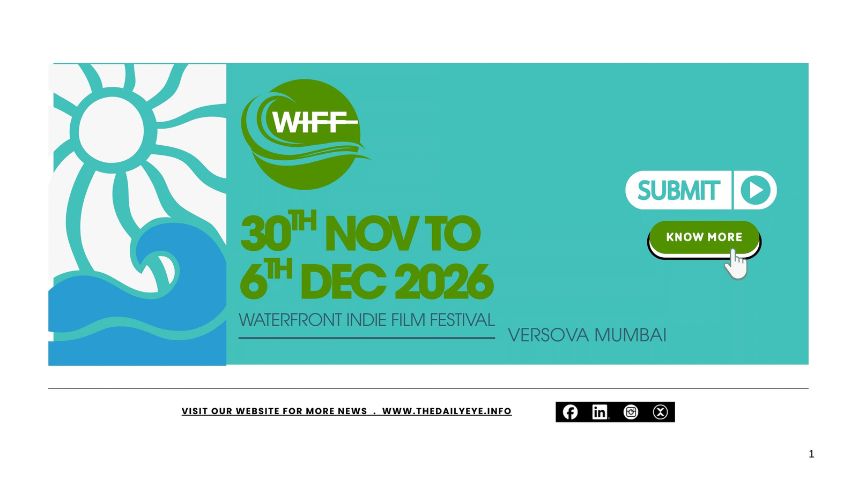
This is one of the reasons platforms such as Waterfront Indie Film Festival (WIFF) Mumbai matter. Established in 2025, WIFF was conceived as a community-driven meeting ground for independent cinema, dialogue and creative exchange. Its second edition, from 30 November to 6 December 2026, will bring filmmakers, artists, technicians, audiences and other members of the creative community together across Third Bell Studios, Silk Road Cafe and Versova SOCIAL in Aram Nagar, Versova, Mumbai.
The significance of such a platform goes beyond screening films. It lies in creating spaces where people can encounter ideas, question assumptions, share knowledge and discover possibilities together. Here, traditional craft and emerging technology need not be adversaries.
An experienced cinematographer can exchange ideas with an AI filmmaker. A production designer can explore new digital tools without abandoning material knowledge. An independent filmmaker can use AI to stretch a limited budget while continuing to collaborate with actors, writers, musicians and technicians.
Such encounters can help us move beyond the polarised argument that we must either reject AI or surrender to it. We can ask more useful questions: Where does the technology genuinely help? Whose consent is required? Which skills should be preserved? Who benefits from the efficiencies created? How do we ensure that the people who make creative industries possible are not excluded from their future?
These conversations must happen not only in courtrooms and corporate boardrooms, but also in studios, classrooms, festivals and the informal spaces where creative communities meet.

The Future Needs People
AI is here to stay. It would be futile to deny its possibilities, just as it would be irresponsible to ignore its consequences. The task before us is to develop a relationship with technology that is imaginative, equitable and conscious of the human beings behind creative work.
Progress should enlarge the creative universe, not shrink the number of people who have a place in it.
The challenge is not to choose between the human hand and the artificial intelligence it has created. It is to ensure that, in reaching for the extraordinary possibilities of tomorrow, we do not lose the human touch that made art worth creating in the first place.