

THIRTEEN DAYS WHEN HUMANITY HELD
by Vinta Nanda July 24 2026, 12:00 am Estimated Reading Time: 10 mins, 48 secsAt an intimate Mumbai screening of Martin Bourboulon’s 13 Days, 13 Nights, the fall of Kabul became more than history revisited, writes Vinta Nanda. It became a story about diplomacy under siege, displacement, moral courage and the fragile choices through which people save one another.
On Tuesday, July 21, 2026, cinema found an unusually appropriate home in Mumbai. At the elegant residence of Patrick Leverino, Consul General of France in Bombay, a small gathering of filmmakers, storytellers and cultural figures assembled for a private screening of 13 Days, 13 Nights, Martin Bourboulon’s extraordinary reconstruction of the French evacuation from Kabul during the Taliban takeover of Afghanistan in August 2021.
Organised by Mathieu Bejot of the French Institute in India for the Consulat Général de France à Bombay, the evening had an intimacy that a multiplex could never have supplied. Among those present were Vaneeta Sridhar and Meenakshi Shedde, alongside an eclectic gathering from Mumbai’s film and cultural worlds. Krishi Dutt, whose VR Films and Studios has brought the film to India and onto its VROTT platform, was there too; his brother and partner Manish Dutt was travelling and unable to attend.
Before the film began, Mr. Leverino put his finger on precisely what made the evening special: “There is nothing quite like experiencing a film together. With lovely conversation over a glass of wine and champagne, of course, because we are French.”
It was light-hearted, but the idea of experiencing a film together acquired another resonance once the lights went down. Because 13 Days, 13 Nights is, finally, about people being forced together by history.
Kabul, August 2021
The date is August 15, 2021. American forces are withdrawing from Afghanistan. The Taliban enter Kabul with astonishing speed. Institutions collapse. Thousands attempt to escape. Images of terrified Afghans surrounding aircraft at Hamid Karzai International Airport travel around the world and become some of the defining pictures of the decade.
Inside the French Embassy, Commander Mohamed Bida and a small security team suddenly find themselves responsible not simply for an embassy but for hundreds of terrified civilians.
Bourboulon’s film, starring Roschdy Zem as Bida, Lyna Khoudri as the French-Afghan humanitarian worker and interpreter Eva, and Sidse Babett Knudsen as war correspondent Kate, was presented Out of Competition at the 2025 Cannes Film Festival. It is based on Bida’s book 13 Days, 13 Nights in the Hell of Kabul, published by Denoël in 2022.
What is remarkable is how little the film behaves like the conventional military rescue thriller it could easily have become. There are guns everywhere, but guns are not the point. Its principal weapons are negotiation, improvisation, persuasion, bluff and compassion.
The real Bida recalled that when the French ambassador left for the airport on August 15, he assumed he would follow within hours. Only around twenty people remained at the embassy. Then Afghans began gathering outside. After an explosion triggered panic and people were being crushed against the enormous embassy gate, Bida warned the ambassador that catastrophe was imminent. The order came to open it.
About 500 people entered. When helicopter evacuation became impossible, another extraordinary idea emerged: buses. Bida began negotiating with the Taliban and eventually secured eleven of them. That convoy becomes the film’s dramatic spine.
Yet the journey is only a few kilometres. What Bourboulon understands is that, in a city where political authority has collapsed almost overnight, five kilometres can become an ocean.
A Thriller Without Manufactured Heroics
Bourboulon had just completed The Three Musketeers: Milady when producer Ardavan Safaee sent him Bida’s book. The filmmaker says he was immediately drawn not simply to the mechanics of the evacuation but to “the powerful human factor.” Within a week he had sent the book to Roschdy Zem. His decision about the film’s tone was crucial.
Bida could have been converted into the familiar cinematic superman: the fearless commander who always knows what to do. Instead, Bourboulon and Zem consciously dismantled that archetype.
The director describes Bida as a man who must summon “courage, determination and especially his compassion” amid chaos. The tiny private moments therefore matter enormously: the trembling hand, the sleeplessness, the instant when the leader is alone and can permit himself the fear he must conceal from everyone else.
Bida himself approved precisely because the filmmakers “de-heroized” him. He remembered fear “in the pit of my stomach” and having to reassure younger colleagues despite having no certainty that any of them would survive. His self-description is strikingly modest: “I’m not a risk-taker, but I am pragmatic and determined. And we got lucky.”
Zem builds his performance around that contradiction. He told the filmmakers he did not want Bida to become a man who effortlessly triumphs over every obstacle. “We wanted viewers to feel his fragility.” The physicality of the performance therefore comes not from combat but containment — anxiety stored in posture, face and gesture. “There’s no fighting going on,” Zem observes, “just tension, hard bargaining and moments of near despair.”
It makes his Bida compelling precisely because he does not appear invincible.
The Astonishing Kabul That Isn’t Kabul
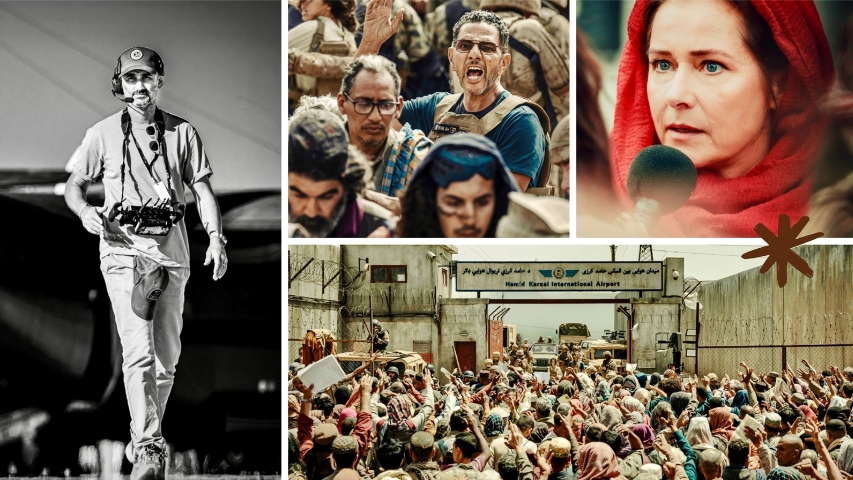
Perhaps the most startling revelation after watching 13 Days, 13 Nights is that the Kabul we have just inhabited was reconstructed. The film was not shot in Afghanistan. It was filmed in Morocco, primarily Casablanca, with the airport sequences made in Kenitra. Bourboulon acknowledges the difficulty: Morocco and Afghanistan do not naturally resemble one another closely enough simply to point a camera and pretend. The illusion required extensive physical reconstruction by production designer Stéphane Taillasson and his teams, combined with Olivier Cauwet’s visual-effects.
That knowledge makes the film's visual achievement all the more extraordinary. Watching it, one can easily assume that Bourboulon has incorporated documentary footage from August 2021. The crowds outside the embassy, roads packed with people, military compounds, checkpoints and airport chaos possess the frightening disorder of news imagery.
But they have been staged. And crucially, they have been staged without appearing staged.
Cinematographer Nicolas Bolduc, editor Stan Collet, production designer Taillasson and composer Guillaume Roussel are among the principal collaborators responsible for constructing this world.
Bourboulon explains that he deliberately rejected conspicuous camera pyrotechnics. The camera would move at “its own pace”, sometimes slightly out of rhythm with the urgency surrounding it. Instead of manufacturing excitement through frantic technique, he wanted the situation itself to generate suspense. The crowds were equally important. Hundreds of extras give the images their terrifying scale.
The effect is almost documentary — not because documentary footage has been inserted, but because fiction has been disciplined by research. Bourboulon and his collaborators immersed themselves in CNN, BBC and France 24 archives, reports in Le Monde, The New York Times and The Washington Post, HBO’s Escape from Kabul, and conversations with French military officers. He wanted credibility rather than spectacle: the events were already dramatic enough. Inventing explosions and action sequences, he believed, would diminish rather than intensify them. That choice is the film’s greatest strength.
The People Behind History
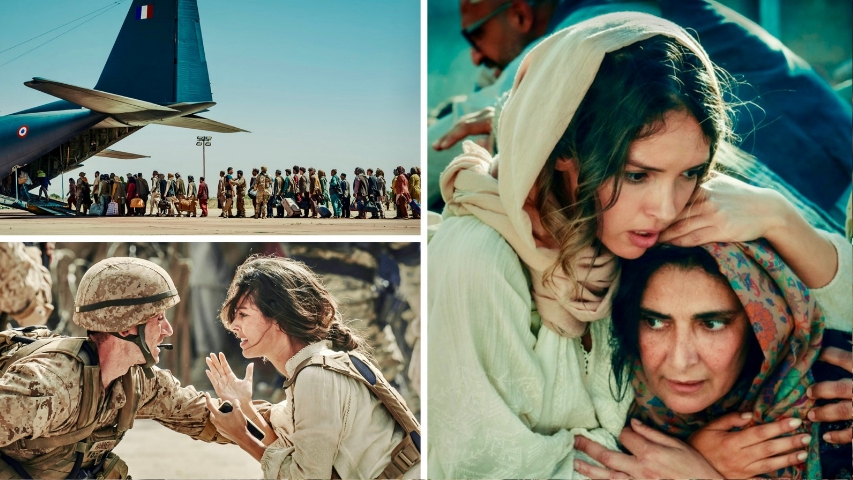
Lyna Khoudri's Eva is a composite character, partly created by merging the interpreter with another figure, while Knudsen's journalist was inspired in part by CNN correspondent Clarissa Ward. Bourboulon wanted the journalist to represent those who become witnesses and narrators when history violently changes direction.
Eva occupies another fascinating space. She translates language, certainly, but also worlds. French and Afghan. Diplomatic and civilian. Those who can leave and those who cannot.
For Khoudri, that question of exile was personal. Born in Algeria, she left as a baby when her family was forced to flee. She speaks in the press kit about displacement being something one carries “in your body and in your DNA.”
Bida’s biography contains an uncanny echo. His father was a Harki who fled Algeria for France in 1962 to escape execution; Bida himself was six months old. Watching Afghan babies being evacuated therefore carried a deeply personal historical resonance for him.
Suddenly 13 Days, 13 Nights begins to reveal another subject beneath the thriller. Exile repeats itself. Borders change. Governments fall. The uniforms change. The frightened families do not.

Why This Film Matters in India
This was also why Mathieu Bejot's remarks before the Mumbai screening mattered. For French diplomats, he said, a film about the fall of Kabul and the French Embassy naturally resonates deeply. But there was another reason for gathering everyone in that room: bringing international cinema to Indian audiences remains difficult. “Getting films released in India is a bit of a challenge,” he said. There is an abundance of remarkable cinema circulating through Cannes and other international markets, yet much of it disappears once it encounters the economics and exhibition structures of India.
Bejot acknowledged the Indian distributors who travel to Cannes and other markets attempting to bring French films home. “It’s difficult to find a space, to find a home for that,” he observed — unless, as Krishi and Manish Dutt eventually did, “you create your own OTT platform.”
That is the other story behind this screening. Krishi Dutt described how VR Films and Studios developed across acquisition and distribution, dubbing, and broadcasting. The company operates more than 85 dubbing studios across India, he said, servicing broadcasters, aggregators and content owners. But for years he encountered the same obstacle when attempting to sell non-English international cinema. Platforms wanted English-language Hollywood films.
Dutt kept asking an obvious question: if Hollywood films could be dubbed into Hindi, Tamil and Telugu, why shouldn't French, Italian or Scandinavian cinema be treated in exactly the same way? “There’s so much hunger where the Indian audience is concerned,” he recalled arguing.
For three or four years, the resistance continued. Finally his brother Manish told him that perhaps the answer was no longer persuading somebody else to provide the platform. They would build one themselves. And VROTT was born.
There is something fitting, therefore, about 13 Days, 13 Nights arriving through that route. A film about people finding an alternative route when the conventional route has closed is itself reaching Indian audiences because its distributor found another way through.

What Cinema Chooses To Remember
There are legitimate questions surrounding any film that turns recent geopolitical catastrophe into a thriller. The evacuation of Kabul cannot be reduced to one country's heroism. The larger history includes two decades of war, occupation, Afghan suffering, strategic failure and the countless people who could not be evacuated.
Some criticism of Bourboulon’s film has centred precisely on its narrow focus: the propulsion of the rescue operation can leave the broader political history outside the frame.
But perhaps 13 Days, 13 Nights works because it understands that it cannot tell everything. It chooses one story. One embassy. One group. One impossible journey. And through that narrowing, something universal emerges.
Bida himself rejected adaptation offers until he found filmmakers who understood that this could not become “an action flick with lots of guns and explosions everywhere.” It needed, he said, to concern “humanity and compassion” and ordinary people confronting extraordinary circumstances.
Zem goes further. At a time when conflicts are proliferating and empathy is increasingly overwhelmed by ideological certainties, he believes the film's insistence upon compassion offers “hope for the human race.”
That might sound sentimental if the film itself were sentimental. It isn't. People are frightened. Officials improvise. Orders become inadequate. Negotiations can collapse. A gate opens because allowing people inside suddenly becomes more important than protocol. Buses appear because helicopters cannot. A commander lies, bargains, disobeys and persists because rules designed for ordinary circumstances cease to answer an extraordinary moral emergency.
And perhaps that explains why Mr. Patrick Leverino and Mathieu Bejot were right about watching this particular film together.
When the lights came up in that elegant Mumbai home, the screening had done what intimate screenings can do at their best. The film had stopped being another rectangle among thousands of titles waiting on a platform.
It had become a conversation. About Afghanistan. About France. About refugees. About cinema. About who gets rescued and who gets left behind. About the people who stand at borders and decide whether rules matter more than lives. And about those terrifying moments in history when institutions collapse and humanity is reduced to individual choices.
Mohamed Bida survived those thirteen days with a phrase borrowed from Mathieu Kassovitz's La Haine. Whenever another obstacle appeared, he told himself: “So far, so good.”
It is an oddly perfect refrain for Bourboulon’s film. Not triumph. Not heroism proclaimed from a rooftop. Just another kilometre survived. Another negotiation completed. Another bus allowed through. Another human being carried towards safety. So far, so good.
And then you keep going.



-173X130.jpg)
-173X130.jpg)


-173X130.jpg)


