

THROUGH AN EYE CURIOUSLY INTERVIEW
by Khalid Mohamed April 22 2026, 12:00 am Estimated Reading Time: 21 mins, 51 secsIn this insightful conversation, interviewer Khalid Mohamed engages photographer Chirodeep Chaudhuri on visual storytelling, Bombay’s evolving landscape, photojournalism’s decline, and the persistence of curiosity in an era shaped by technology and change.
This in-depth interview by Khalid Mohamed with photographer Chirodeep Chaudhuri explores the evolving language of photography in India, the disappearance of photojournalism, Bombay’s changing urban identity, and the impact of digital technology and AI on visual storytelling. Through reflections on decades of work, influences from global masters, and deeply personal projects, Chaudhuri articulates the importance of curiosity, archival responsibility, and long-term engagement with subjects. The conversation offers valuable insights into contemporary Indian photography, media transformation, and the challenges faced by independent image-makers in an increasingly commodified visual culture.
An image-maker who doesn’t follow photography’s stylistic mandates, he grabs whatever catches his eye—be it whimsical, the everyday grind of the metropolis, stolen moments from the tumult of travelling on local trains, and way more. Indeed, his range of images can’t be compartmentalized, except for the fact that variety is the impetus of a rooted-in-reality credo.
That’s Chirodeep Chaudhuri, born 54 years ago to Subir and Kanika Chaudhuri; his father worked at the Philips company, his mother was a homemaker. A commerce graduate from Swami Vivekanand Education Society, Chembur, he went on to acquire a journalism diploma from the Xavier’s Institute of Communications. His wife, Rohini, after many years in luxury retail, is now a home-chef and runs her own catering business called Spices & Friends.
A thoroughbred Bombaywalla, for almost eight years now he has avoided a 9-to-5 job, given the nature of his projects, which he describes as ‘niche’. Moreover, the changing media landscape has not made it any easier to land the kind of work he is now dedicated to.
Here's diving deep, then, into the heart and mind of the image-maker Chirodeep Chaudhuri. Excerpts from a conversation with Khalid Mohamed.
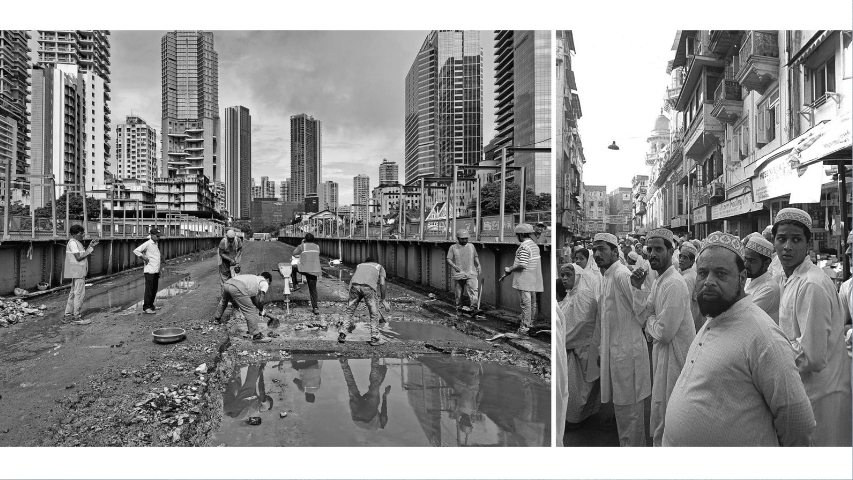
Influences, Obsessions, and the Bombay Lens
I first came across your images on Instagram. Some of your interests, if not obsessions, are quirkily mundane moments on local train rides, a search for clock towers, age-old fonts on shops and buildings, and accidental moments of the city and its people. Am I correct in assuming this?
You are correct, but perhaps only partly. My interests are in subjects as varied as history, archaeology, architecture, and design. Publication design has been an area of tremendous interest since my early days in journalism. I am interested in cinema but not in music. Technology—the social aspects of it more than the science—arouses my curiosity. And Bombay, the city I have grown up in, draws me towards issues like public transport, urban design, civic issues, and infrastructure. The ecosystem of the city’s local trains fascinates me endlessly. For people-watching, an indulgence of mine, could there be a better place than the local trains? The clocks are a long story. I can be quite obsessive in my pursuits, and I have found this to be true with many of my projects, which seem to take over my life and mind once I start sensing something developing.
My interest in the city’s public clocks has been a pursuit that is 30 years and counting.
You have exhibited your images frequently and published books. Which books, especially, were the most creatively satisfying ones?
That would have to be A Village in Bengal: Photographs and an Essay, published by Picador (India) in 2012. It was the culmination of 13 years of photographing the nearly two-centuries-old Durga Pujo in our family home in the Burdwan district of West Bengal. A large section of the learning curve of my career coincided with the making of this work.
I was still new in my career when I first visited my ancestral village in the late 1990s, which was all very exotic for a Bombay boy who had never really experienced a Bengal village. And then, to witness a Durga Pujo which was so different from my Bombay experience of it during my growing-up years. I discovered and made connections with my very large family that I always knew I had but never really knew well. I returned the next year and the year after that and slowly began to think that, maybe, this should be a book.
The problem, however, was that I didn’t know how to do one, and I didn’t find anyone who could guide me. And that’s where a huge learning happened—and like all good education, it was thrilling. I began, strange as it may sound, by watching Pather Panchali. Some of my friends here were comparing my photographs to that film, perhaps because their only reference to the rural Bengali way of life was also mostly through the films of Satyajit Ray. Frankly, I was very bored watching Pather Panchali the first time, but I persisted and watched it again some days later. I began to read Ray’s writings—in the lucid and easy-to-grasp book Our Films, Their Films. This is what I mean by a good education which puts you on a path, a quest, and much discovery.
I discovered the joy of films; Ray led me to Akira Kurosawa and Alfred Hitchcock and many others. I was reading Walter Murch and Michael Ondaatje in the book In Conversation and discovered that what they were talking about—building narratives—was a similar struggle that Eugene Smith had been grappling with in his monumental photo essays like his Pittsburgh work. These were my struggles too. The rhythms of life in rural Bengal, I discovered, were much like Ray had described—where nothing much seems to happen.
At the end of 13 years, when the book finally happened, I had become a better photographer. The experience had, to put it simply, made me richer in the end. Beginnings, Media Influence, and the Power of Images
I read an interview of yours in which you said a copy of a vintage LIFE magazine picked up from a pavement shop was the kick-off point for your journey into photography. Can you recall its cover and some of the photographs you were struck by?
Yes, very vividly. It had, on its cover, a black-and-white photograph of a little girl in a woollen cap lighting a candle during a protest march in 1989 or 1990. Nicolae Ceaușescu’s regime had ended, and there was civil unrest in Romania. There were other stories too—one on the Leaning Tower of Pisa and the work being carried out to arrest its tilting, another on the ‘cutest baby in America’, and one about an old man who loved surfing.
I had never seen LIFE magazine before that, nor had I seen photographs like the ones in that issue—I mean, ‘consciously seen’. My interest in photography and journalism was kindled on picking up that magazine (I still have it and many other LIFE issues I collected after that). I often walk by that patch of the footpath opposite the CTO office near Flora Fountain and, not seeing the pavement booksellers, tell myself that had I not found that magazine, I would never have become a photographer.
The Berlin Wall came down some months later. Those were momentous times, and my impressionable mind was ready to be influenced by all that I was seeing in the magazines and on BBC News. Satellite TV was new too, and I believe that my exposure to the 24-hour world news cycle only heightened my gravitation towards journalism and the desire to become a photographer—to be in the midst of events and not just read about them.
Has any mainstream magazine over the decades done justice in giving its due space and importance to photography?
Unfortunately, none has been consistent. I have heard that the Illustrated Weekly, while Pritish Nandy was its editor, was a photographer-friendly publication. I have been told by Palashranjan Bhaumick, who was a photographer there, that Mr. Nandy was a ‘photographer’s editor’. During my career—and it’s been a little over three decades—I have seen and worked at publications which have, for periods, been sensitive to the use of photography, but then that almost always changed over time. A lot of newspapers, like Hindustan Times when it launched in Mumbai, were giving photographs great display, but that is not the case anymore.
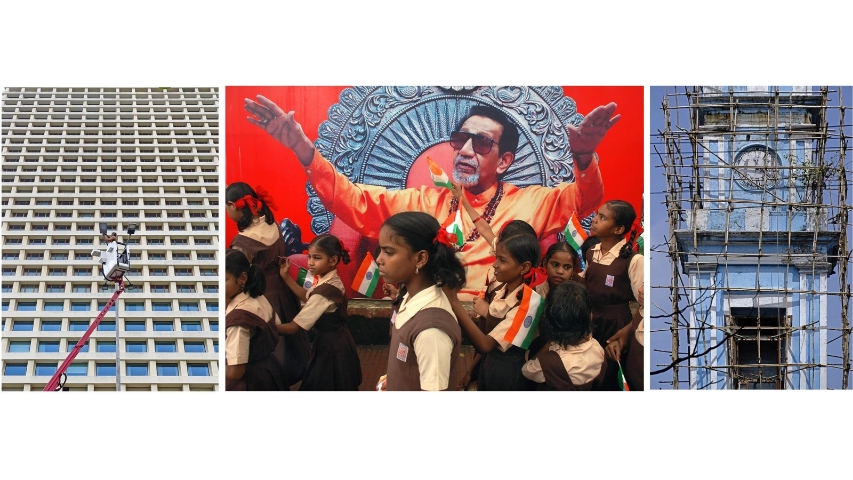
Practice, Process, and the Obsessive Eye
Point-and-shoot appears to be your style, if it can be called that. How do you approach photography, by and large?
My photography projects are really driven by my obsessive nature. I like to keep digging and pursuing an idea for long periods of time. I am often asked whether I get fed up. Of course I don’t, because then I wouldn’t keep chasing and searching and developing those ideas. I have been looking for Bombay’s public clocks, for instance, for the last 30 years.
When I first began photographing them, I had no idea that my pursuit would be stretched over such a long period of time. But that’s because I didn’t know how many there were or how the subject was going to turn out—and the amazing history of time in the city that I would discover along the way.
For In the City, a Library, a collaboration with my friend Jerry Pinto, I photographed around 250 books from the collection of The People’s Free Reading Room & Library for two years. We were attempting to tell the story of the slow death of an important city institution. The forgotten books, many damaged and decaying, became the metaphor. It was also the story about the fragile nature of knowledge and the loss of the reading habit.
When I was photographing the pavement-dwelling cancer patients outside the Tata Memorial Hospital, it was just nine or ten days of shooting over nearly nine months. Most of the time there was spent chatting with the families of the patients on the pavement, trying to collect their experiences and stories.
I rarely begin work on my ideas as ‘projects’ that must be completed, exhibited, published, or shared. Naturally, I want that in the end, but it is never the agenda when I am beginning. I think one must be committed to the idea. And so, I have no timeline in mind. People usually get very hung up with those numbers—three decades, 13 years, or a certain number of books over two years—but as far as I am concerned, most of my works are cumulative, and the final edits usually comprise a very large number of photographs and text.
Learning Through Newsrooms and Mentors
You have worked at the outset as a trainee and then progressed towards more responsibilities. Which of the newspapers or magazines was the most ideal and the most disillusioning?
Honestly, I don’t think any were disillusioning. There may have been phases during various jobs when one felt bored to death. But then, that’s the case with any job. This, unfortunately, we realise only in hindsight. One of the real positives for me had been my seniors, especially during my first two jobs.
One was at the Sunday Observer, where the head of department, Vijayan Raghavan, would often talk about films and filmmakers and books and writers. It was an education I hadn’t signed up for but happily sat through. I aspired to have negatives as fine as Vijayan’s. Seeing his negatives and the care with which he printed sharpened my technical skills—something I lacked when I joined the paper.
At the Outlook group, being around Prashant Panjiar, I learnt to have a more holistic view of working in a publication—as someone who developed a deeper understanding of the written word and magazine design, and how photography could be used. Much of the learnings from these jobs, and all the reading and thinking I was doing all along, were what I put into action when I was heading the photography and design teams at Time Out’s India editions.
Let’s hypothesise. What vocation would you have opted for if not as a photographer?
Oh! I don’t know. I began my career in advertising as a visualiser. I used to always draw through school and college. For a while, I had imagined a career that would utilise my drawing skills, and so advertising had felt like the right choice. But it was also pure naivety and ignorance that made me think so. I realised that only once I got into the profession.
I guess my visual sensibility, in the end, came in handy when I became a photographer. I say this because I don’t think one can be talented in the use of a machine, but the machine can become a tool to harness certain sensibilities.
Funnily enough, in the late 1980s, I had dreamt of being a cricketer when Sunil Gavaskar scored all those centuries and Ravi Shastri hit boundaries and sixes and became the Champion of Champions. I would also imagine myself as an archaeologist reading about excavations in National Geographic. Both were pure fantasies.
Of young Indian photographers, a majority share the same subjects: sunrises, Bandra’s old houses, revelry, reflections/juxtapositions—in general, pretty pictures. Is this because the viewer essentially wants to see or buy upbeat images? The unsettling ones are shunned, except perhaps by overseas photography agencies, explaining why Pablo Bartholomew’s images, ever since the 1970s, have received more exposure.
That problem honestly arises because one has limited exposure or because photographers are merely looking at the works of others rather than engaging with the broader ideas that matter to them. They end up referencing the works they like or admire. This is bound to happen. For instance, what you say can be seen very clearly in this age of Instagram.
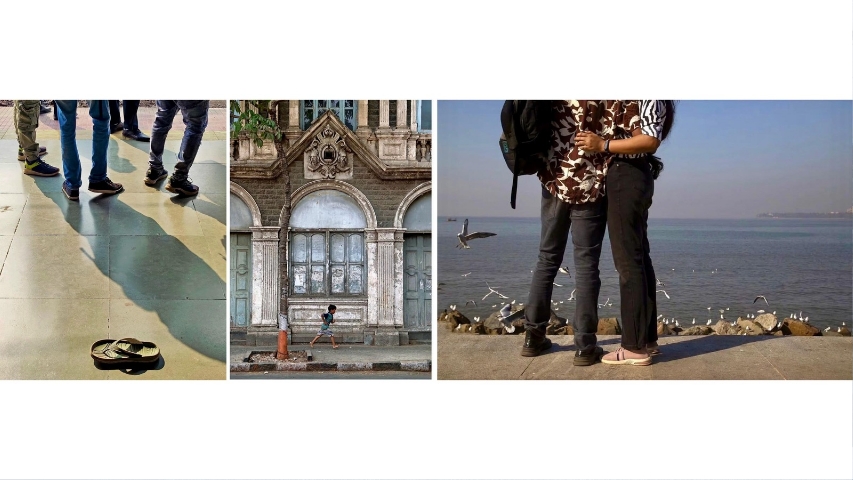
Influences Across Photography, Film, and Literature
Okay, so in this order, which photographers (Indian or global), books, artworks, and films have influenced you in a direct or subconscious way?
My earliest influences in photography were Henri Cartier-Bresson, Eugene Smith, Gordon Parks, Elliott Erwitt, to name a few. These were the names I was discovering from the issues of LIFE from those pavement stalls. I later began to follow the works of Walker Evans, Eugene Atget, and Bernice Abbott. When we were beginning our careers, Steve McCurry was a photographer who influenced many of us, and I think that was mostly also because his books were more easily available.
Once I began travelling through India on work, I realised that his work was not necessarily showing me the India I was seeing. One became more aware of the problems of a particular gaze, and so one discarded that influence.
As far as books go, I don’t think I can pinpoint one. I was reading a lot of reasonably dense material and a lot of theory and critical analysis of the works of the photographers I admired. These were the kinds of books I would get Strand Bookshop to procure for me. As far as films go, like I mentioned before, my education really began with Satyajit Ray and then branched out from there.
The Decline of Photojournalism
Photojournalism is almost dead. I was appalled while at the Hindustan Times when an editor had suggested doing away with photographers and depending on reporters who could capture news images on cell phones. Your take on this?
It is a terrible move. I think it is really driven by budgetary concerns, with no thought for the readers of newspapers and magazines. I think as editors—who are really the arbiters of taste and thought for their readers—this move ensures that readers are fed a poor-quality diet of aesthetics.
From the perspective of what material and information you are leaving behind, in terms of knowledge of the times, we are creating an ocean of inarticulate visual communication. It’s an archive which, though it will exist, may have little qualitative value when we look back. And that is because the communication skills have been flawed from the very beginning.
I don’t have a problem with images being captured on a cell phone; it is with the low level of skill of those gathering the information. Technical skills can be imparted, like you could teach anyone to use a typewriter—that’s not a talent. But not everyone can be a writer just because they can work a typewriter. Unfortunately, in the long run, readers will be less discerning of quality and less demanding too.
Archives, AI, and the Uncertain Future
Sebastio Salgado concentrated on the inhuman conditions of the labour force throughout the world, his criticism being loud and clear. Would a Salgado-like, or someone distantly close to his approach, be allowed here?
Salgado can’t exist in a vacuum. His works have to be published in books. Organizations have to offer backing and funding to produce work of that nature. Art needs patronage not just money. Of course, there is personal drive. But that needs the system.
I always thought my friend from Shillong, the late Tarun Bhartiya’s work reminded me of Salgado’s in scope and intent. Tarun never liked that comparison but that’s because, I think, he disliked hero worship. If you see his work, his new book, Em No Nahi, you will probably agree with my opinion.
That work about the 90-year-old Kong Spillity Lyngdoh Langrin’s defiance against those who wanted to exploit her land for mining which features Tarun Bhartiya’s photographs and journal notes has recently found an audience through a book. But it also required a publisher like Yaarbaal Books. I don’t think the existing publishers of photography-oriented books would have the courage to publish that. I’m willing to be proven wrong.
I know of Indian photographers (like Adnan Abidi of Reuters) who bravely reach war zones, but seem to self-censor themselves in the images posted. Consequently, we see only ‘half-baked’ images released by the western media. Or am I being paranoid?
This is a very complex matter. Indian media used to once tell stories of people. We don’t anymore or certainly not enough. In general, the important stories of our times are not being told in the media today. That is a casualty of the last decade or so. I don’t think it matters if a photographer shows personal initiative and goes out and does a story if the avenues for those stories and photographs to reach an audience are vastly compromised or depleted.
Photography regrettably remains largely insular, arousing fleeting curiosity among a stray few collectors or confined within the photographer community? Has it been accepted as an art form in India?
Earlier, in the times of analogue, it was an expensive pursuit. It made one more careful and circumspect while shooting and one also had to work towards a certain degree of technical proficiency. It didn’t necessarily mean that everyone was equally skilled. There always existed strong communities, perhaps each even pursuing genres – like wildlife photography enthusiasts, photo-journalists, the landscape guys and the salon photographers who preferred black and white. I don’t recall in my early days any of us ever referring to ourselves as ‘artists’. Of course, we aspired to have exhibitions of our work and that was not always easy because there were only public galleries which gave precedence to painting over photography most of the time.
So, the big guns got shows and the rest sat in hope. Things may have changed somewhat with the emergence of private commercial galleries and an interest in photography from buyers. But I don’t think there is an active scene that photographers can depend on – a scene would mean informed critics, opinion shapers, talent spotters, galleries that are open to showing varied kinds of works, buyers who are eclectic in their tastes and have the right sensibilities and publishers who will present opportunities for publishing works. All of this exists but it is not in proportion to the burgeoning numbers of practitioners which has largely happened due to a technology shift.
How are your digitizing your images over the decades. And can you tell me about the inevitable shift from analogue, including developing photos in dark rooms, digital and the ‘ominous’ or ‘welcome’ arrival of AI?
I too shifted to digital when the world transitioned from analogue. I, however, have been slowly digitizing my work once scanning of negatives began. I am obsessed with archiving my work and have created my own systems to be able to access and repurpose the works.
I loved being in the darkroom but that is now very difficult to do. I am a compulsive shooter and was a compulsive print maker. Now that that has become difficult, I have had to modify my processes and workflow to be able to constantly see and review a large numbers of images which I tend to produce for my projects.
About AI – I’m sure it would, in times to come, have an impact on livelihoods of photographers. It already is. Right now, much of AI imagery is in the frivolous territory like those pictures of Brad Pitt or Leonardo DiCaprio taking a dip in the Ganges. But I see images used in newspapers like Mumbai Mirror, AI generated images, to illustrate crime stories, for instance. Those images are given a three-column display! One knows that an image of that kind is not possible for a photographer to produce. They used to be very realistic and one wonders where the line would be drawn about what is acceptable or desirable.

Bombay’s Transformation and the Need for Memory
You seem to be a cat lover, with four or five of them at home. Ever thought of a series on stray cats and dogs since they’re under threat now?
Yes, we have four cats at home. They are a constant source as far as photographic subjects go for both my wife and me. In fact, about 11 years back when we got our first cat, Chingri, my wife had been doing more pictures of her than I was. I had then designed and published a small book called The Book of Chingri largely comprising of Rohini’s photographs.
About stray dogs, in the late 1990s I had produced a series of photographs on them. Of course, there was little interest in it then barring dog lovers and my friend Abodh Aras who runs Welfare of Stray Dogs.
You seem to be rarely interested in the drastically changing skyline of the metropolis, except the ones you come across accidentally, like a Jurassic-like Park in the suburbs…. Do you think we’ll have enough images of Bombay the way it was? We don’t have a really strong archive of the mill workers’ strike and the closure of the mills either?
Oh! I am very much into the changing physical look of the city. I have been photographing the large-scale transformation of Mumbai since work began on the coastal road project before the COVID pandemic. The work really emerged from the very thing you mention – would we have enough photographs of the Bombay that was?
These photographs of various construction sites stretching from South Mumbai to Central Mumbai, deep into the suburbs is to create a record, for the future, of what this city looked like while it was changing. That work is on-going just as the transformation continues. I haven’t shared much on social media to keep it fresh for a potential exhibition in the future.
About the mill strikes, I am sure newspaper archives would have material. How well they are archived and accessible is another story. Archiving is a matter of vision. You organize it keeping future use in mind. Photographers have done work on the fall-out of the mill strike but little has been seen and in the public domain as much as it should have been.
A Restless Mind in Changing Times
How would you describe yourself as a photographer right now: restless, unsure, focused, or open to experimentation?
All of these. I don’t think I would have lasted as a photographer for this long if I didn’t have a restless streak in me. Curiosity, I believe, is the most important trait for a photographer. I am a very focused person; I set goals for my projects—those could be fluid initially—but I know where I am heading with my ideas.
I am unsure because such are the times we live in. Who could have imagined that at a time when we would be at the peak of our skills, we would be facing challenges of obsolescence posed by technology and the environment we operate in?
I am open to experimentation, but I also know my limitations, and things that don’t hold interest for me—I would not waste my energy experimenting in areas that don’t engage me. Having said that, I never thought I would get the opportunity to shoot moving images. I recently shot for a short film. I was most excited, but it also made me very nervous. As they say, “You can’t teach an old dog new tricks,” I don’t see this as a new career path, but for the moment, I am most enthused by the prospect of seeing the results.
Independent Voices, Alternative Storytelling, Offbeat Cinema, Beyond Mainstream, Indie Culture, New Voices New Stories, Experimental Art, Independent Creators, Counterculture,




-173X130.jpg)
-173X130.jpg)
-173X130.jpg)
-173X130.jpg)


-173X130.jpg)