
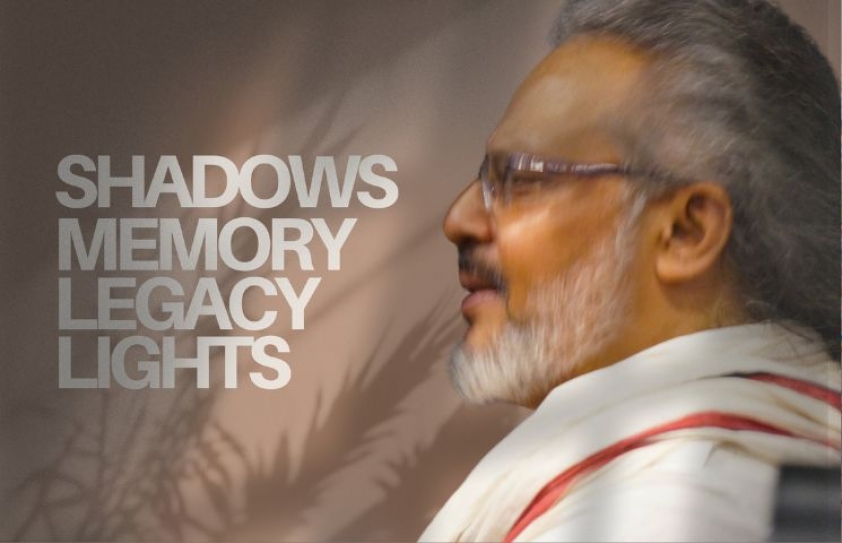
FESTIVALS: SHADOWS, MEMORY, LIGHT, LEGACY
by Vinta Nanda November 28 2025, 12:00 am Estimated Reading Time: 6 mins, 39 secsA riveting journey through cinema, ethics, forgotten theatres and artistic truth with filmmaker and archivist Hemant Chaturvedi — a powerful exchange of memory and meaning documented, and interviewed by Vinta Nanda after WIFF Mumbai 2025.
Renowned cinematographer and heritage photographer Hemant Chaturvedi — known for films including Company, Makdee, Maqbool, 15 Park Avenue, Ishaqzaade, Kurbaan and Arjun: The Warrior Prince — delivered one of the most impactful sessions at WIFF Mumbai 2025. His archival documentation of over 1,250 single-screen theatres across India, paired with his documentary Chhayaankan: The Management of Shadows, now stands as one of the most important visual preservation projects in Indian cinema history. With theatres vanishing and analogue filmmaking culture fading, Chaturvedi’s work captures memory in a way India urgently needs but has rarely attempted.

A Session That Felt Historic
At the Waterfront Indie Film Festival (WIFF) Mumbai 2025, something extraordinary unfolded inside a darkened auditorium. Cinematographer, archivist, artist and relentless documentarian Hemant Chaturvedi took the stage — and for almost five uninterrupted hours, he held a roomful of filmmakers, students, scholars and cinephiles in absolute silence.
With sharp wit, deep knowledge and fierce clarity, he walked the audience through decades of Indian cinematography, the emotional architecture of image-making, and his monumental mission: documenting India’s disappearing single-screen theatres — buildings that once held the collective cinematic heartbeat of the country, now dying quietly, demolished without record, meaning or ceremony.
That evening, when his film Chhayaankan — The Management of Shadows screened, the weight of its purpose became undeniable. The documentary — the first and only film made in India about cinematographers — felt less like storytelling and more like cultural preservation.
A Life Behind and Beyond the Camera
Hemant Chaturvedi spent nearly three decades working as a cinematographer in Mumbai before stepping away from mainstream filmmaking in 2015. His cinematography credits include Company, Makdee, Maqbool, 15 Park Avenue, Ishaqzaade, Kurbaan, Brothers, and the animation feature Arjun: The Warrior Prince.
Today, his work is self-directed, self-funded and research-driven — spanning abandoned cemeteries, Dhrupad gurukuls, old Zoroastrian Aram Gahs, deserted idols and what is now considered the largest documentation of single-screen cinemas ever attempted globally.
Despite international media coverage, academic admiration and presentations for institutions like INTACH, Film Heritage Foundation and Art Deco Mumbai, formal backing and publishing offers have been slow, exploitative or dismissive.
Yet, he continues — because the erasure continues.
Following his WIFF presentation — while the energy of the room still pulsed with images of abandoned projection rooms and faded velvet seats — we spoke.
59.jpg)
Your motivation to spend a substantial number of years documenting single screen theatres in India?
The entire project began unexpectedly, I had not even considered the subject ever. I happened to be in Allahabad in Jan 2019 for the Kumbh Mela, I had booked a tent accommodation at the Sangam, got cheated by the organiser, and went back to my ancestral home in the city. A couple of days later, frustrated and disappointed, I decided to take a walk with my camera bag and visit the gorgeous Science Block at Allahabad University. While strolling along, a flash of déjà vu led me to a cinema of my childhood holidays in Allahabad, and it had been shut for 20-25 years. Out of curiosity, I requested the owner (a family friend) to open it for me and let me photograph it. Since I had the time, I did the same with three more old cinemas in Allahabad and came back to Bombay.
Research revealed India had lost over 14000 single screen cinemas from 24,000 between 1990 and 2019. One thing led to another, a project I began as a small documentation of a rapidly vanishing cultural era, ended up as a gigantic visual conservation effort. I realised that every cinema I visited had a unique story and often some historical cinema objects that I needed to preserve in photographs.
So 7 years later, I have driven 60,000km through 21 states and photographed over 1250 single screen cinemas. And within this period, the total number has dwindled to barely 2000, and I suspect the next two years will see the almost complete erasure of a century long history of cinema exhibition in India. Of the 1250+ that I have photographed, more than half don’t exist anymore.
As preservation of Indian cinema history, how do you feel this collection of photographs is going to enrich future generations of filmmakers and cinephiles?
I guess it’s just a way of creating a visual memory archive complete with the stories that accompanied these spaces, a way of making subsequent generations aware of the entire cosmos that existed around these temples of mass entertainment. And also the extraordinary architecture and the evolution of technology that saw cinema reach its pinnacle and its subsequent fall. With the mass produced and generic multiplex spaces of today, and the manner in which India is being rapidly transformed into one of the ugliest countries in the world, let these photographs be a reminder of our exceptional aesthetic past.
What is it that drove you to produce and direct Chhayaankan?
The last few years of my three decade career as a Cinematographer had raised many questions about professional ethics, aesthetics, morality and integrity.
As these fundamentals had begun to disappear in the professional sphere, I realised that remaining honest and true would end my career very quickly. So I decided to walk away from Cinematography in 2015.
The purpose behind Chhayaankan was to find an answer to many of my questions, and to create a unique film that could possibly help guide young professionals (and remind older ones), to lead professionally holistic lives in an era where integrity has vanished.
The story was told through the interviews with 14 of the 17 cinematographers I had approached between 1985 and 1990, looking for an apprenticeship. While working with Merchant Ivory and Doordarshan etc. simultaneously and attending college! Three of my stalwarts had passed away long before I began the project.
So what emerged was an honest and heartfelt film about cinematographers and cinematography, a department of filmmaking that continues to be ignored by the world of cinema…strange how even today, a film poster will carry the names of the lyricist, the dialogue writer, even the costume designer, but not of the Director of Photography. It’s shameful.
As a cinematographer yourself, how much did you learn as well as unlearn about your art in the process of making the film?
In a nutshell, I learned that I had conducted my career with commitment and grace, and that it is important to realise and acknowledge when it’s time to move on, before you get sidelined and discarded by a very fickle and selfish industry.
Luckily I left at a perfect moment, and I have never regretted it even for a moment. In the last ten years I have done more meaningful work, more historical and timeless projects, that working on a movie would never have offered. And I was reminded of what someone had told me way back in 1985, “Bhidu, iss dhande mein picture nahin chalti hai, keval kismat chalti hai.” So true. Some of the most talented people fall by the wayside, and mediocrity rules…
Lastly, a few words about your experience at WIFF Mumbai 2025?
The WIFF was a splendid experience, and I was grateful for the amount of time given to me to present both my projects, the single screen cinemas lecture and the screening of Chhayaankan. We had a full house and a great cross section of a very intelligent and participative audience. It could not have been better!
Closing Reflection
When the applause finally receded and people stepped out into the Mumbai evening air, there was a shared sense that something had shifted — not just intellectually, but culturally.
Hemant is not merely documenting old buildings or past practitioners.
He is preserving what a nation forgets fastest: craft, labour, legacy, memory — and dignity.
His work stands as testimony, and testimony is survival.



-173X130.jpg)
-173X130.jpg)


-173X130.jpg)