
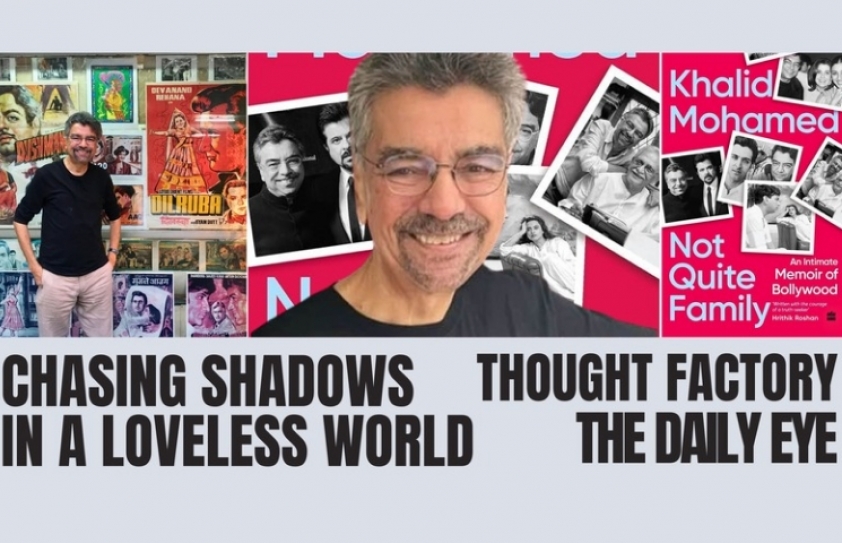
CHASING SHADOWS IN A LOVELESS WORLD
by Brij Sharma July 6 2026, 12:00 am Estimated Reading Time: 4 mins, 28 secsBrij Bhushan, journalist and author, reviews Khalid Mohamed's Not Quite Family: An Intimate Memoir of Bollywood. Recently published by HarperCollins, the memoir exposes Bollywood's fractured loyalties, newsroom politics and personal losses with wit, candour, and unsparing emotional honesty.
Despite his forays into scriptwriting, filmmaking, novels and memoirs, I count Khalid Mohamed as a film critic at heart.
He elevated the genre. The reviews of his predecessors like Amita Malik and K. A. Abbas showed no trace of zing or panache, no knack for wordplay. They were as straight-faced, if not monotonous, as Salma Sultan, that overrated Doordarshan anchor of their time. They never learnt the art of lacing and larding the final product with the Ajinomoto of humour.
Baburao Patel of the notorious and collectible Filmindia fame could be acerbic, yes. But so conscious of his self-importance as editor that oftentimes he'd be querulous, mean or downright insulting. His review of Dev Anand's Afsar warned potential viewers "to avoid it on health grounds."
Khalid, by contrast, is like Peter Bradshaw of The Guardian – sophisticated and tongue-in-cheek, compelling you to re-read him thanks to his turn of phrase, wordplay and a Tharoorian vocabulary, with Ajinomoto sprinkled in every helping. No wonder Ashok Kumar would phone him specifically to point out his funny phrases. Now, after reviewing hundreds of films, Khalid has finally come out with a review of his own life, meshed as it was with the worlds of cinema and journalism.

Bollywood, Journalism and a Life Remembered
It is titled Not Quite Family – An Intimate Memoir of Bollywood. The title is taken from the bogus declaration by a Bollywood czar's wife. The czarina told him he was family but wouldn't acknowledge his greeting after a 'bad' review of a czarist film.
Woven into his reminiscences of the high and mighty, the hoity-toity and the hoi polloi of Bollywood – you whisper the name and they are there between the lines – are his elevating and crushing experiences in the world of journalism, largely at The Times of India and Filmfare. Interleaved with all this are engaging accounts of the making of his film trilogy Mammo, Sardari Begum and Zubeidaa, directed by Shyam Benegal.
His childhood was spent in his grandfather's bungalow on Malabar Hill, as large as any successful film star's, with a garden and fruit trees. His mother, after Khalid's father went away to Pakistan, married the then Maharaja of Jodhpur, Hanwant Singh, and died in a plane crash when he was two. He was brought up by his maternal grandmother, who had passed away by the time he directed his own first film, Fiza (2000).
Encounters with Cinema's Icons
In this literary concertina based on his interviews and convivial conversations, with the persons of interest stretching from Salim Khan, Dharmendra, Dilip Kumar (a family friend), Rajesh Khanna, Rekha and Amitabh Bachchan to Vidya Balan, Smita Patil (a college mate) and Asha Bhosle, Khalid offers cameos that make you LOL, fill you with anger, and astonish you with the temerity of some of the idols with feet of straw. Salman Khan's dad gets away with calling him a haramzada, Vidhu Vinod Chopra uses mc and bc expletives, and Big B implies he is a drag queen – Begum. And all for refusing to praise a dud bullet in his reviews.

The Price of Speaking the Truth
The Times of India – the Old Lady of Bori Bunder – didn't treat him any better, and his tenure as Filmfare editor was not even half as smooth as that of his predecessors, with a good many years spent, chaprasi-like, chasing film stars to appear and perform at their Awards ceremonies.
The few other papers he joined were equally exploitative. The policy seemed to be 'use and throw'.
Khalid's reviews were not merely reviews, good or bad, but first-class pieces of humour, a delight to read, and the 'badder' the film, the more delightful the review. But he came on the scene a bit late. The age of suave, well-educated actors like Balraj Sahni (who had taught at Shantiniketan and worked with the BBC), Prithviraj Kapoor (the only graduate in the Kapoor clan), Chetan Anand (who taught at Doon School), Dev Anand (Master's in English from Lahore), Dilip Kumar and Dharmendra, gentlemen all, was passing. They were men who had made it on their own and had learnt the grammar of decency and the rules of social conduct on the way up.
By the time Khalid came on the scene, nepo-kids had begun to mushroom, brash, brusque and boorish, with nothing to show but their silver spoons and lack of education, some unable even to name our prominent ministers.
There were exceptions, but the majority of them had had it all before the first clap of their muhurat shot. These bouncers expected the last link between the theatre and the audience – the perceptive film critic – not to come in the way with a review that'd hurt them, their producer, their director – everyone on the assembly line.
A Memoir That Dissects Two Worlds
As for good journalism, it ended when the new generation at The Times of India came on the scene with advertorials and paid interviews, and the virus spread.
Here is a book on the twin subjects of Mumbai cinema and journalism, with their scarlet underbellies laid bare on the dissection table.



-173X130.jpg)






-173X130.jpg)