
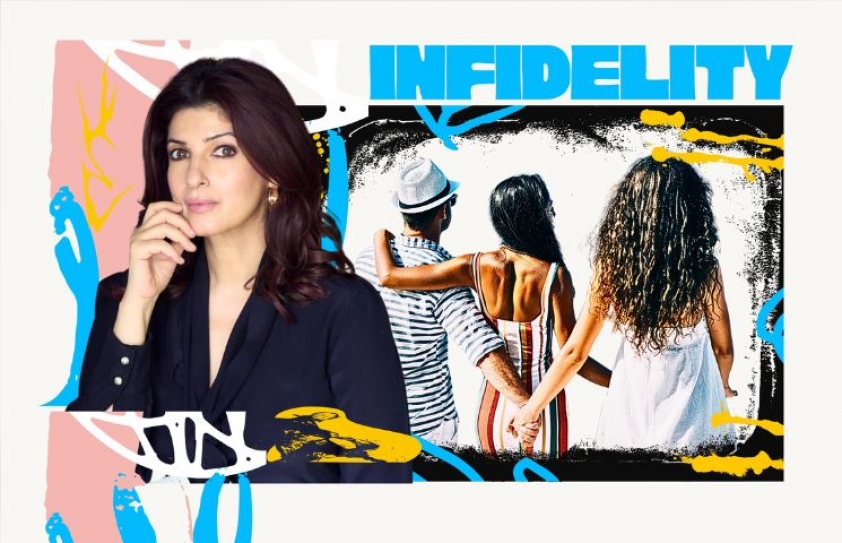
GENDER: WHEN FIDELITY MEETS MODERN DESIRE
by Vinta Nanda December 5 2025, 12:00 am Estimated Reading Time: 3 mins, 35 secsTwinkle Khanna’s remark on marriage and infidelity sparked nationwide debate a couple of weeks ago, and Vinta Nanda discovers new data which suggests that nearly half of India may already agree—monogamy isn’t always natural, and relationships are evolving beyond old rules.
Twinkle Khanna’s comment on Two Much (Amazon Prime) — that infidelity is not a dealbreaker in marriage and that “raat gayi, baat gayi” should often be the approach — triggered a social media storm. Coincidentally, the 2025 Gleeden–IPSOS Infidelity Study has revealed shifting attitudes in India, with 43% believing humans are not meant for monogamy and 61% asserting that loyalty is a choice, not biology. With changing cultural values, rising emotional disconnect, and technology playing catalyst, the debate around fidelity, marriage, and modern love has never been louder.
The Pop-Culture Spark: Twinkle Khanna and the Raat-Gayi-Baat-Gayi Approach
A few weeks ago, what seemed like a throwaway line on a streaming show quickly became the subject of think pieces, memes, and moral outrage. Twinkle Khanna—known for her sharp satire and unfiltered humour—suggested on Two Much that infidelity doesn’t have to destroy a marriage, and in some cases, letting it go may be the more practical route.
For some, her words felt refreshing—recognising marriages as evolving emotional contracts rather than rigid rulebooks. For others, it felt like a betrayal of cultural values, a frivolous dismissal of hurt and trust.
But behind the opinions and outrage, something else emerged: curiosity. The question shifted from Should infidelity be forgiven? to Why is infidelity happening—and what does modern India really feel about loyalty?
The timing could not have been sharper. Just as the debate reached fever pitch, the Gleeden–IPSOS Infidelity Study dropped numbers that shook assumptions: almost half of India believes monogamy may not be natural. Suddenly, Twinkle Khanna’s remarks looked less like provocation and more like observation.

The Numbers Behind Desire: India’s Quiet Reality
The Gleeden–IPSOS Infidelity Study surveyed more than 1,500 respondents across Tier-1 and Tier-2 cities and uncovered striking patterns. Emotional disconnect (51%), work-life imbalance (33%), and dissatisfaction with intimacy—especially among Gen Z—are major triggers.
Even more telling is the emotional shift:
- 58% believe infidelity can fulfil emotional needs.
- 53% say infidelity doesn’t need to end a relationship.
- 47% think it can even save one.
This isn’t rebellion—it’s reflection. As Sybil Shiddell, Country Manager at Gleeden India points out, infidelity is increasingly being viewed less as moral failure and more as unmet need. Her statement reflects a softer cultural tide: relationships are expected to grow—and sometimes grow imperfectly.
Interestingly, Tier-2 India is leading the mindset shift. Jaipur (52%), Patna (46%), and Indore (69%) show higher acceptance of non-monogamous thinking than metros. The stereotype that smaller cities are more conservative may now be officially outdated.
Digital intimacy is another disruptor:
- 68% say social media enables infidelity.
- 64% admit to flirting online while committed.
With smartphones acting as emotional escape valves, relationships are facing a new dimension: the affair of the mind—private, accessible, and blurred in definition.
65.jpg)
Beyond Shame and Shock: The Redefinition of Commitment
So, is India becoming less loyal? Or simply more honest?
The winter metaphor used in the Gleeden report captures this shift beautifully: cold winds evoke both longing and reflection. As relationships evolve, so does the vocabulary surrounding them. The romantic ideal of one person forever is being questioned—not abandoned, but interrogated.
Some love stories thrive in monogamy. Some evolve into companionships that allow emotional flexibility. Some, as Twinkle Khanna bluntly suggested, survive with forgiveness as a practice, not a weakness.
And perhaps that is the biggest cultural turning point—not the acceptance of infidelity, but the acceptance of complexity.
The question today isn’t:
“Should infidelity ever be forgiven?”
But rather:
“What do relationships truly need to last?”
As India enters this conversation—with humour, resistance, curiosity, and discomfort—one thing is clear: marriage is no longer just a ritual. It is a negotiation, a dialogue, and sometimes, a recalibration of expectations.
Winter may spark longing—but it is also the season of truth. Is India is finally speaking it?




-173X130.jpg)

-173X130.jpg)

-173X130.jpg)
-173X130.jpg)