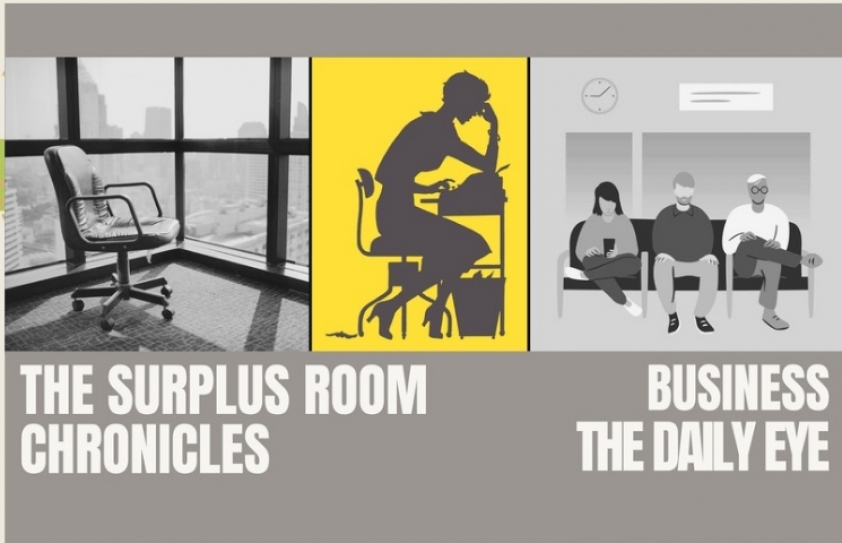
THE SURPLUS ROOM CHRONICLES
by Shrishti Shree May 16 2026, 12:00 am Estimated Reading Time: 6 mins, 26 secsShrishti Shree revisits a disturbing chapter in Mumbai’s newspaper industry, where journalists were isolated, silenced, and psychologically cornered under the guise of employment, exposing the harsh realities of contractual labour, union struggles, and institutional intimidation.
Around the beginning of this century, while the world was technically progressing, newspaper policies were regressing. I have a strange story to tell, about a paid imprisonment within a newspaper building’s walls, in Mumbai. I won’t name the paper; suffice it to say it was, and is still, one of the country’s leading newspapers. I was a reporter, copy editor (called a sub-editor in those days), as well as an occasional photographer for this paper, since I had a diploma in photography from the J.J. School of Arts.
The Beginning of Isolation
One fine day, I was asked by the manager of the Personnel Department to quit my desk in the editorial room and go sit in Staff Room No. 1 on the second floor. I thought it was for some w huork, so I told him I needed to go to the library first for some research work for a write-up. He brusquely told me that the paper had no place for my write-ups and I had to go sit in this special room from then on. I would be paid my salary.
Since I didn’t understand that and must have looked at him uncomprehendingly (therefore stupidly), he squinted at me and commanded in his strong Malayali accent, ‘Follow me, I will show you the room,’ and walked off. I followed him meekly to a rather sparse room with a window, on the second floor. It had many chairs and just one table, with an ancient rotary telephone propped up on it. ‘Sit,’ he barked and, like an obedient dog, I sank into a chair, still confounded by the developments.
Soon, other journalists from the editorial and magazine sections walked in. They looked as dazed as I was, wondering what had hit them. Finally, we were told that our respective departments were not happy with our work and so we had to sit in that room, without access to other parts of the building. The canteen was the exception. But all of us were reassured about our salaries. Those would not stop.
There were many breaking stories I wanted to file and also take some photographs I had planned out. I stubbornly fought the stigma and consistently returned to my desk in the editorial department, only to be recalled into what came to be called The Surplus Room. But who had decided that we were all surplus? Why us? This question kept tormenting us all.

Journalism, Fear, and Punishment
Our Joint News Editor told me that neither he nor his team was responsible for this and that it was the Personnel Department that had taken this decision and had asked them to comply. To be honest, I didn’t know whom to believe. I was sure that, after a while, the newspaper would make a case against us that we were not performing, yet were being paid. Because we were told to sign the muster during entry and exit, with the time mentioned. It was a clever ploy to get rid of us for reasons best known to them. Unemployment would stare us in the face. Who would take journalists in their late 40s, made surplus by their company? Many of us withered at that thought.
We were supposed to be present from 10 a.m. to 5 p.m., in the same room, except for meal times. The Editorial Department used to turn up at 3 p.m. to put the paper together. It was irritating to turn up at 10 a.m. in the crazy rush hour, and then twiddle our thumbs till 5 p.m. We were not allowed to roam in the corridors or even visit our places of work. It was like a full-day detention. I had a suspicion it was my union work involving the Majithia Wage Board that had brought this ‘punishment’ about.
The Wage Board Battle
Let me explain this. The contract system had started by then. It involved a contract between the employee and the employer for a certain duration of time. Those who worked under the wage board were old employees, having spent two or three decades with the same company. Contracts enabled the company to get fresher, young recruits, with the freedom to terminate their employment whenever required.
We saw that as a way of firing us. Those who agreed to work under contractual employment got higher pay, while people like me, who came under the wage board, got meagre salaries. It will be difficult to understand this today, because contractual employment is the norm everywhere. The old days, where one was judged by the number of years spent in one company, are gone. Today, a loyalist of even 10 years is under suspicion for having stayed in a company for a decade.
Well, this was what the fight was about, and I was very much a part of it.

Inside The Surplus Room
But what about the others? There were 50 of us in one room, and nine of us in the other. They looked confused, miserable. Some would stare into the air; some would mutter. One of them would suddenly laugh. Another looked out of the window and commented on the Kanjeevaram saris being worn by female labourers. Yet another looked longingly at the mango-nibbling parrot on the tree outside and wondered when he would be as free as that bird again. They sounded like prison inmates!
Yet they were not willing to support me in this fight. Their response was that at least they were getting their wages, so they preferred to depend on the mercy of the employer. I was bugged by their cowardice and consulted my lawyer. He warned me that if I disobeyed the office order in any way, I could be suspended, as they were paying me my salary.
Fighting Back Against The System
‘The salary’ became a bone of contention for me. Finally, the Bombay Union of Journalists recommended a lawyer who had got journalists and workers reinstated in a case where a magazine of the company had shut down. He promised to fight the case and said he would charge a basic sum and not take anything more if the workers won the case against the employer.
I wrote letters to the Personnel Department. To no avail. The Personnel Manager who received those letters had been an ordinary employee once but had been elevated to his managerial position for various reasons, including sycophancy. But he didn’t realise that he was also under the wage board and hence a surplus employee too!
We moved court and coordinated with the lawyer for the victimised journalists and workers, finally getting a draft ready for the case. The others refused to put their names down. When I threatened them with a 2,000-rupee fine on behalf of the lawyer for cancellation of their names, they relented.
And so we proceeded with the case. The case took time… had its ups and downs. The ‘inmates’ lost patience and the room emptied slowly, as people resigned and quit the company. Finally, I left the company but kept fighting. We won the wage board case in the Supreme Court. The full amount of my compensation was challenged by the company. I took whatever was offered to me and resigned.
Business And Power, Capital And Control, Corporate Influence, Policy And Profit, Political Economy, Markets And Morality, Wealth And Inequality, Boardrooms And Ballots, Economy Explained,



-173X130.jpg)
-173X130.jpg)
-173X130.jpg)
-173X130.jpg)

-173X130.jpg)
-173X130.jpg)