
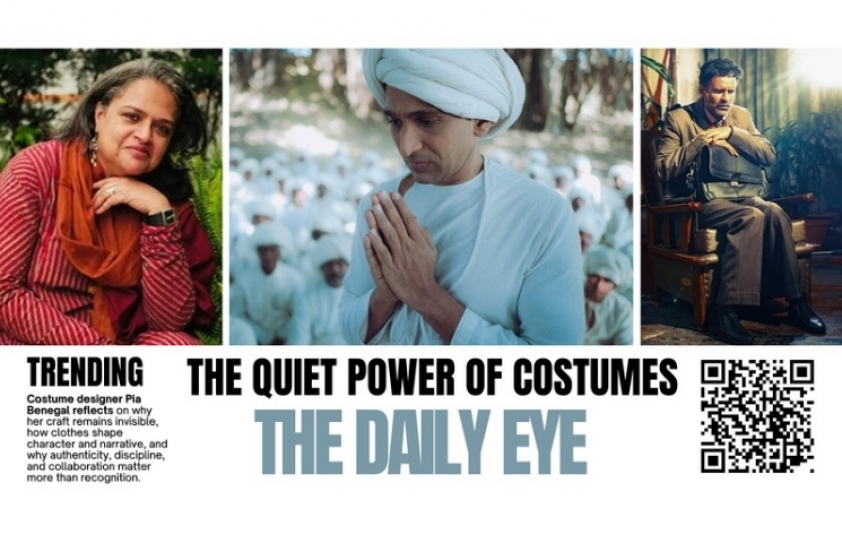
TRENDING: THE QUIET POWER OF COSTUMES
by Pia Benegal January 16 2026, 12:00 am Estimated Reading Time: 3 mins, 28 secsCostume designer Pia Benegal reflects on why her craft remains invisible, how clothes shape character and narrative, and why authenticity, discipline, and collaboration matter more than recognition in cinema’s complex, collective storytelling process.
Why Costume Designers often go unnoticed! Pia Benegal reflects on Storytelling Through Clothes and a Career Shaped by Observation. Renowned for her meticulous attention to detail and storytelling through costume, Pia has designed iconic characters in films such as Govind Nihalani’s Droh Kaal, Mani Ratnam’s Dil Se, Shyam Benegal’s Zubeidaa, and Hansal Mehta’s Aligarh and the most recent Gandhi. She reflects on the invisible yet essential role of costume design in cinema, exploring how clothing shapes character, period authenticity, performance, and storytelling while highlighting collaboration, discipline, and the quiet power of truthful visual narratives.
When cinema is discussed, conversations usually revolve around performances, direction, dialogues, and music. Yet, many of the elements that make characters believable and worlds feel real remain quietly unnoticed. Costume design is one such craft, which is deeply connected to storytelling, but rarely spoken about on its own.
Costume designers are not meant to stand out. Their work is designed to merge seamlessly into the narrative, so the audience never pauses to admire the clothes separately. I believe this invisibility is often a sign that the work has succeeded. If costumes begin to draw attention to themselves, something is not right. The clothes should feel like they belong to the character. The audience should believe the person on screen, not the styling.

Learning Cinema Through Observation
My career has been guided by this belief. Having grown up around cinema, I learned early that filmmaking is a collective process, built on observation and trust. Over the years, my work has focused on understanding characters deeply—their social background, emotional state, environment, and the time they belong to. For me, costume design has never been about fashion or spectacle, but about truth.
I have made sure that the costumes I work on are known for their strong sense of period and place. Whether it is historical cinema or contemporary narratives, my work has always felt rooted and lived-in. The clothes do not overpower the scene; they quietly support it. Even today, audiences respond to this honesty. The designs continue to feel relevant because they are grounded in character and culture, not trends.
A well-crafted costume allows actors to inhabit their roles fully. It shapes how they move, sit, speak, and exist within a scene. It also helps the audience understand time, geography, and social reality without being told directly.
These details may not always be consciously noticed, but they strongly influence how a story is experienced. One cannot dress actors like Rekha or Karisma in heavy, flashy bridal wear in a royal or restrained setting—the clothing must reflect the world of the story, not distract from it.
The Discipline Of Staying Unseen
Costume designers often remain unseen because their contribution is meant to be invisible. Their success lies in serving the film rather than seeking individual attention. Cinema is never about one person. It is about many people coming together to tell one story honestly.
The craft also demands discipline and humility. Costume designers work closely with directors, actors, cinematographers, and production designers, constantly adjusting their work to align with the film’s larger vision. This collaborative approach may leave little space for personal spotlight, but it results in work that stays with audiences long after the film ends.

A Shift In Conversation
In recent years, there has been a growing curiosity about the many crafts behind cinema. Conversations around costume, production design, and research are becoming more visible, particularly among film students and young professionals. I see this shift as encouraging.
For younger designers, it’s important to understand that recognition may come late, or sometimes not at all. But the real reward is seeing a character come alive on screen.
This reflection is simply an acknowledgement of a craft that works quietly, shaping stories from behind the scenes. Costume design may not always be noticed—but it is always felt.







-173X130.jpg)
-173X130.jpg)
-173X130.jpg)