
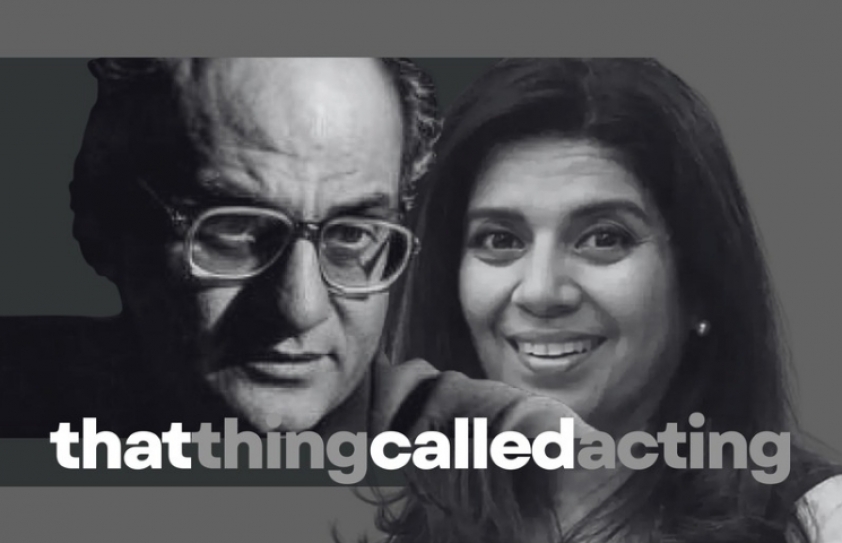
POWERFUL PEOPLE: THAT THING CALLED ACTING
by Khalid Mohamed November 25 2025, 12:00 am Estimated Reading Time: 16 mins, 37 secsMita Vasisht, whose career has spanned over four decades of film and web series acting, theatre, documentaries, besides being an educator and activist in the rehabilitation of sexually abused minor children, interviewed by Khalid Mohamed on her wide spectrum of roles, integration into different art forms, and her recent feature-length documentary on the iconic, rule-bending auteur Mani Kaul.
In this expansive and deeply insightful conversation, acclaimed actor, theatre practitioner, educator, and activist Mita Vasisht reflects on her four-decade artistic journey shaped by collaborations with legendary auteurs Mani Kaul and Kumar Shahani, mainstream filmmakers like Subhash Ghai and Mani Ratnam, and her transformative work with trafficked minors. Her reflections encompass the making of her fiercely personal film Mani Kaul and That Thing Called the Actor, her sociological understanding behind portraying Kalyani in Delhi Crime 3, her experiences confronting patriarchal industry hierarchies, and her evolution as performer, producer, and creator across cinema, documentary, theatre, and independent art practices. This piece explores her views on women’s representation in Indian cinema, the decline of institutions like Films Division, the crisis in indie filmmaking, and her philosophical approach to love, motherhood, purpose, and uncompromising artistry—offering a rare, unfiltered gaze into one of India’s most original and steadfast artistic voices.
It’s been a long and winding ride, spanning over four decades. And she’s done it all – films of the supremely artistic kind, the fantasy-crammed formulaic, and the unintentionally absurd. And she shows up in web series in a variety of roles ranging from the impactful to the okayish.
Vis-à-vis theatre, she has walloped out solo acts, besides featuring in short films. Of late, she has self-funded a documentary on the iconic auteur Mani Kaul, which, apart from a screening at Delhi’s India International Centre, still has to be exposed to a wider Indian and global audience.
That’s Mita Vasisht, now 58, born to evolve in the performing arts, a game-changer who still has to receive her deserved batch of honours and bouquets.
Procrastination isn’t in her vocabulary, and I say this because circa the 1990s, I had asked her for a Filmfare photo-session. The top-of-the-line photographer wanted her to look bold and sensual, organising a somewhat skimpy leopard-skin outfit to pose among the thickets and rocks of Goregaon’s Film City. There wasn’t a word of protest from her that the photographer was out to objectify her.
Rather, she knew how to outwit him, and the photographs, which were used finally, showed her as a young woman with a feisty and distinct independent bravado. The photographer admitted, “She knows how to let the camera respect her. I was trying to make her look like a sexy calendar girl but she outsmarted me, I haven’t clicked such aesthetic images before.”
That’s just one incident that underscores the actor’s self-worth and her ongoing potential as an actor of spleen and substance. I hadn’t met Mita Vasisht in years, who has always been a text message away. Consequently, here’s a conversation between the chameleon-like Ms Vasisht. Excerpts:
How do you look back on your days of initiation into the acting process?
In my younger days, I would celebrate the fabulous roles I had been blessed with, and also go into a deep angst over the roles that had been snatched away at the last minute, or chopped drastically to favour a co-actor. It would be heartbreaking but it would impel me to move ahead despite the obstacles.
Yeah! I did have frequent private angry tete-a-tetes with god and tell him, “Listen, if you have given me the talent then you had better give me the roles.”
But then later I’d introspect, “Are accolades going to determine my path? If I am a gifted actor, then the ‘gift’ stems from another source. It is my duty to act, not to await accolades or the ‘result’. There is a certain joy and centeredness in being free of both praise and criticism.
Could you elaborate?
All spiritual teaching, whether Buddhism or the Bhagavad Gita, speaks of what we now call ‘occupation hazards.’ Just about two years ago, I came to know that 25 years ago I had been given an award by the Bengal Film Journalists’ Association for Govind Nihalani’s Drishti.
I learned about this accidentally when it appeared on a listing of awards won by me on a social media post. I asked Govind if this was correct and he said yes…but I didn’t ask him why. He didn’t offer an explanation, I let it pass.
I did think about what the award might have meant for a young actor, just a few films old, to have celebrated this very prestigious award then? Would it have meant more roles? Would it have elevated my status? More than anything, wouldn’t the award have given me a morale boost when the going was tough? Wouldn’t it have made my parents beam with reassurance and pride?
Anyway, this is how it was meant to be or else I may have sat back on my laurels --- I realise today that the wonderful thing is the constant adulation I get from the audience after as many as 40 years. There is no “Once upon a time when I was…” for me. It’s in the here and now that, as an actor and as a woman, we walk hand in hand.
Is there any role in films you lost out on because of your uncompromising nature?
Yes, a lead role in a Telugu film years ago. You might have forgotten…at the Madras International Film Festival in 1991…when I ran into the room where Kumar Shahani, Ashish Rajadhyaksha, you and several others were partying. A celebrated Telugu film director was running after me, all lust-full red in the face and in a state of disbelief that I had just turned down his offer of a lead role because it meant ‘living in’ with him till the film was done.
Ha, ha! I remember him stopping shock still, coming face to face with Kumar Shahani, who gently asked him to calm down and have a drink. And the fellow just turned and fled.
And a very famous Hindi film director told me, “No one is ever going to cast you in a main role—it’s written all over your face, that you won’t sleep with anyone for a quid pro quo.”
Initially I was devastated, thinking if this is how it all functions then there is nothing for me here. Yet there was always this arrogance, which I consider a healthy quality, by the way, that no one is doing me a favour by casting me. I deserve the best and yes, acting is a sacred space. It is not for sale or negotiations.

How would you describe yourself: restless or stable?
Deeply stable while I am working on a role, performing and more so when I am directing. I used to be restless once. And you know what? I do regret the caustic tongue and the brilliance with how that would dismember men. I now practise detachment, which is probably a mix of experience and calmer hormones.
You spoke about reassuring your parents. How far did they influence you?
I did defy my father to walk the actor’s path. In 1983, acting as a way of life was unheard of.
My father, Rajeshwar Dutt Vashist, was an artillery officer, which meant postings in unheard of places far from the cities. I have two younger brothers. At times, I would have to go to a school under a tent set up by nuns who had travelled for our education’s sake to a wilderness.
It was a landscape of adventure, learning and just about making do with whatever was available. For instance, I wanted to learn to play the piano but how could we find a tuner in the back of beyond and lug the piano around every two years of a new posting? So my parents gave me a guitar instead.
My father had fought on the front in all the three wars 1962, 1965 and 1971. But as a kid I was never made to feel the fragility of his life during his absences by my mother, Meenakshi, who was a true-blue army wife, only 22-years-old, lugging a one-year-old me in her arms, when she waved bye-bye to my father as the train full of army officers and soldiers chugged out of the Delhi railway station in the winter of 1962.
So I grew up with a pair of parents who lived by their values, both unafraid of the unknown and the unexpected and always celebrating daily life in ordinary things.
My dad’s favourite quote has stayed with me forever, “When the Great Scorer scores, and writes against your name, he does not see the prize you won, but how you played the game.” Dad’s junior officers, the jawans and senior officers loved him but his immediate boss, the Commanding Officer, sometimes didn’t—ironically that’s what saved his life during the Chinese operation.
Which books and films impacted you in your growing up years?
The first book at the age of six years that my mother read aloud to me was The Adventures of Tom Sawyer by Mark Twain. On birthdays the only gifts we were given were books --- all the Enid Blytons and Amar Chitra Kathas. Then there were the classics - Moby Dick, Wuthering Heights, Little Women and Lorna Doone, Mill on the Floss, the whole lot.
Films were Hindi films - all those exciting ones like Dharmendra’s Yakeen and Shammi Kapoor’s Teesri Manzil. With the Rajesh Khanna era in the early 1970s, I was forced to give up my crush on Dharmendra and to embrace Rajesh Khanna under peer pressure! Of the American films there were so many: The Longest Day, Patton, the Clint Eastwood westerns, the comedies of Goldie Hawn, Liza Minnelli’s Cabaret and of course, Robert De Niro’s Taxi Driver.
To cut to your documentary on Mani Kaul. Can you tell me why Mani Kaul and not Kumar Shahani whom you collaborated with in equal measure?
My documentary Mani Kaul and That Thing Called the Actor (with the tagline A Continued Remembrance of Mani Kaul) is a 96-minute work of fiction – not a documentary in the conventional sense. Siddheshwari was my first full-length film. Mani had seen me in Kumar’s short film Var Var Vari and had immediately cast me for Siddheshwari without having met me or even spoken to me. At our very first meeting, Mani had said, “You know casting is the worst thing I could have done to my film because you are a trained actress.”
I had just finished three years at the National School of Drama in 1987.
Today, I think that was the perfect hook, to thread a film from which was deeply about the actor’s craft from our eastern treatise of the Natyashastra. Mani was a scholar of the Natyshastra even though he spoke extensively of Robert Bresson.
Natyashashtra and the cinema of Bresson are not contrasts to each other. Kumar was a whole world, cosmos rather, by himself. I had a very different artistic journey with him --- it needs another documentary which I aspire to do some day.
As someone who has been an activist in the prevention of sex trafficking in minor children, it was quite odd to see you playing Kalyani, the ferocious sex trafficker in Delhi Crime 3 web series.
More than prevention, my initial five years of work with trafficked minors was to use theatre as a tool to help them overcome the trauma, the physical mental and emotional scars of the phase of their lives in the brothels. This helped them to return to mainstream society without a trace of what had happened to them.
Twenty years later some of us are still in touch over the phone.
My work with the trafficked minors earned me their trust and they would tell me the real stuff, even though I never asked them a single personal question. Oddly enough, I learnt that it was the ‘Nice Aunty Next Door’ type of woman that most sex traffickers are.
So, I played the role of Kalyani in Delhi Crime 3 based on the sociological understanding of traffickers I had learnt from the trafficked girls whom I had trained in the theatre at the remand homes.
In fact, the staff and the government employees at the rehabilitation centres are often quite horrible to the girls — taunting them and destroying their already shredded sense of self. Working with the trafficked kids was quite a revelation to me of what our country is all about.
There were some wonderful, really caring ladies and citizens on the Child Welfare Board, but some real horrors in the government bureaucracy.

You have worked with Subhash Ghai, Mani Ratnam and other directors in mainstream cinema. Is that scene a different ball-game altogether?
It’s different because in the mainstream cinema there are so many hierarchies in all the departments and at all levels that you wonder how they ever make films.
I had come from a clear democratic set-up where even as a lead actor and star, there were no special privileges. I had to share a room with the girl assistant director in Kumar’s Kasba, and with the costume designer in Siddheshwari. We were all in our 20s then.
Moreover, a huge amount of money is wasted in mainstream cinema on completely unnecessary things. It’s somewhat like our country today. Only a few are excessively privileged while the others are made to feel like underlings, and often behave like underlings too… it’s awful. Even though I was not at the receiving end of it in a severe sort of way, it just feels rotten to the core.
But then it’s not just about the film industry. The rest of the hierarchies in our country itself are idiotic beyond belief.
Are you embarrassed by any of your performances in retrospect and regretted them?
Yes, there’s that stupid so-called mainstream film Aladdin and my role in it as the karate instructor. I had publicly declared then I will drown its director, Sujoy Ghosh, ha ha!
Did marriage to filmmaker Anup Singh alter your priorities at all?
It did... but then we divorced for various reasons. Still, I went from being purely an actor to becoming producer and a script writer (on two television serials for Doordarshan and Zee TV) and also Anup’s film The Name of a River – on which I was everything -- producer, line producer, make-up girl, choreographer, spot boy, liaison-in-charge, location hunting, post production assistant, hard-boiled production manager, the whole shebang.
Did you ever want to have child or adopt one?
I fancied the idea of having a child but that instinct was not powerful enough, even adoption was considered. Thankfully some sensible friends made me realise that loneliness or the idea of having some ideal in life to devote yourself to aren’t valid reasons to adopt.
I think I put my nurturing instincts to positive use with the 80 and more remand home trafficked minors, in looking after my parents, some elders in the family, my dogs and cats and my students in the theatre. Above all, perhaps I have had to adopt myself.
For 21 years now, I’ve been performing a play on the life and mystic poetry of Kashmir’s iconic Lal Ded. She followed a soul calling and never longed to birth a child. The Kashmiris, both Pandits and Muslims, call her Lala Meuj (Mother Lala). She is their beloved and shared archetype.
I think this business of mother hood is over rated. It would have been a life wasted if I’d had a child. To what end? What would have been the purpose?
To come back to the documentary on Mani Kaul, why hasn’t it been shown at festivals or streaming channels?
I have not looked for buyers. I will not part with this film. I am not looking to recover the invested money. I just want it to be seen by everyone in India.
A producer at the Film Bazaar in Goa in 2022, who had seen the rough cut of the film in the viewing room, said something very beautiful, “Don’t be in a hurry to sell your film to recover your money. Treat this film as an investment, not as a product.”
I was so happy, that is exactly what I feel. I am working towards the Mumbai premiere in January and the film will chart its own course, I know.
Why is there a polarised response to the works of Mani and Kumar, from say the Film and Television Institute of India, Pune students who either idolise or demonise them as ‘arty’?
That phase is over now. I know over the years, students of film direction at Subhash Ghai’s Whistling Woods study Mani’s films even though that’s not in their syllabus.
Recently I was approached by a major fashion house in Delhi to model for their indie brand. They sent me a bunch of photos about the kind of image they wanted for their brand. Three of the photos were stills from Kumar’s Khayal Gatha. When I told them that, they were pretty red-faced.
Another high fashion brand did a campaign called Peacock Country for their saris. It was a straight lift from Khayal Gatha --- the images, the postures of female bodies — everything.
Do you see the notion of “Let a thousand flowers bloom” coming to life ever? For instance Films Division has been dismantled.
Film Division was a wonderful institution --- so much great cinema came from it, a number of Mani’s films; Arrival and even Siddheshwari, or earlier M. F. Husain’s Through the Eyes of a Painter.
Are there any backers for Indie cinema?
In India, I think not. All the independent cinema of India is being backed by overseas funders.
Where do you see yourself as an artist today – at the crossroads or….?
I am clear about my rules in life and acting. There’s no confusion there. This is a path without compromise.
Do you think in the 2000s, the representation of women in cinema has altered or is it mere tokenism?
Those who make the rules of the film industry are men, mostly very patriarchal.
How can there be a real true representation then? At most, the representation of women is surficial. It’s not their fault, they don’t know better.
You’ve expressed your wish to direct a feature film. Could you give me a hint on its theme and how you could raise funds?
I have two feature film scripts written years ago that are relevant today --- the storylines are radically different but strangely both of them are about a woman demanding unconditional love from life.
What is love?
Ha, is that some question? All I can say is that love is way more than just a four-letter word.
To conclude, I have written a solo play Love Real and Reel and my favourite yodel when I sing to myself is Love is a Many Splendored Thing.



-173X130.jpg)


-173X130.jpg)
-173X130.jpg)

-173X130.jpg)